AI co-workers are software agents, copilots, and digital assistants that now sit alongside human employees as functional members of a team — attending meetings, drafting deliverables, flagging risks, and completing bounded tasks with limited human oversight. Humans and AI work together best in a delegated-and-reviewed model: AI handles retrieval, first-draft generation, and pattern recognition at scale, while humans own judgment, context, relationships, and final accountability.
Key Takeaways at a Glance
- AI co-workers are now a standard part of the modern team, not an experimental add-on — most digital workers collaborate with multiple AI agents weekly.
- The winning model is delegation with clear review, not full automation or full resistance.
- Manager training, not tool adoption, is the real bottleneck for most organizations.
- Roles are being redesigned around a task layer (AI-assisted) and a judgment layer (human-owned) — leaders need to map this deliberately, not let it happen by accident.
- Treating human-AI collaboration as a capability to build — through leadership reforging, cultural rewiring, team alchemy, and future mindsets — outperforms treating it as a software rollout.
What Does It Mean to Have an "AI Co-Worker"?
For most of modern work history, a team meant a manager, a group of human colleagues, and the scaffolding built around them — org charts, performance reviews, hiring pipelines, succession plans. That scaffolding assumed every seat at the table was filled by a person.
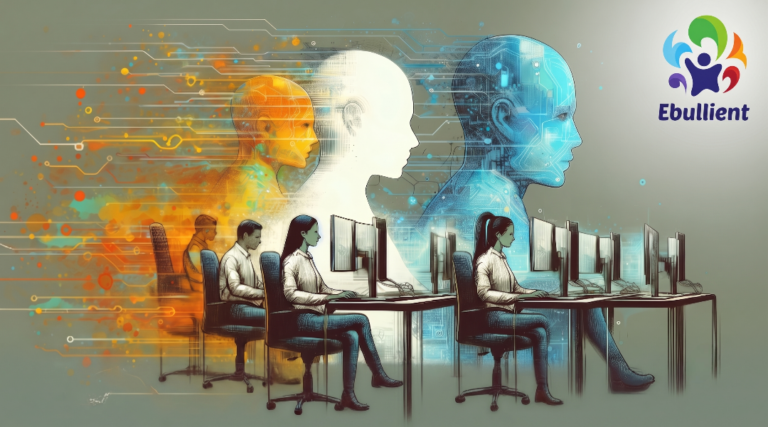
That assumption is no longer holding. The average knowledge worker today collaborates with multiple AI agents alongside human teammates — tools that draft documents, summarize meetings, flag anomalies in data, and increasingly make small operational decisions without asking for approval first. Some workers now send a digital twin or notetaker to sit in on meetings in their place.
This is the reality Ebullient Consultancy sees across the leadership programs we run: the “team” is no longer a purely human unit. It’s a hybrid one. And most organizations have deployed the technology faster than they’ve redesigned the roles, the trust, or the management habits around it.

Source: Deloitte
Did You Know?
87% of digital workers now use AI at work, and the average employee collaborates with three or more AI agents alongside their human teammates. Yet only a small fraction of leaders say they’re actually leading well through this shift — Deloitte’s 2026 Global Human Capital Trends report found 85% of leaders call adaptability critical, while just 7% believe they’re leading on it.
How AI-Ready Is Your Organization, Really?
Take our free 4-minute assessment and get a personalized report on your leadership fluency, governance, and workforce readiness.
Take the Free AI Readiness Assessment →Why Are Companies Bringing AI Onto the Team, Not Just Into the Toolkit?
Three forces are converging, and none of them are going away:

1. Capability gaps are widening faster than hiring can close them
Specialist skills — data analysis, technical writing, code review — are in short supply. AI agents fill the gap at scale, not by replacing the specialist but by extending what one specialist can cover.
2. Decision cycles are compressing
Organizations that pair AI with clear escalation paths report meaningfully faster decision cycles — not because AI is deciding, but because the right information reaches the right person without a manual search.
3. Work itself is being unbundled
Roles that used to be a single job description — “customer support rep,” “financial analyst” — are splitting into a task layer (increasingly AI-assisted) and a judgment layer (still firmly human). Nearly 40% of roles in large global enterprises are expected to involve direct engagement with AI agents, reshaping how entry-level, mid-level, and senior jobs are designed.
This isn’t automation in the old sense — machines replacing a fixed task. It’s closer to what Ebullient calls capability building as a competitive advantage: the organizations pulling ahead are the ones treating human-AI collaboration as a skill to be developed deliberately, not a tool to be switched on.
It also isn’t a phenomenon confined to any one industry or function. Engineering teams use agents for code review and test generation. Finance teams use them to draft first-pass variance analysis. Sales teams use them to prep call notes and draft follow-ups. HR teams use them to screen resumes and draft job descriptions. The specifics vary by function, but the underlying shape is the same everywhere: a task that used to require a person’s full attention now requires a person’s judgment applied to a machine’s first draft.

Source: Medium
Did You Know?
Agentic AI job postings grew roughly 280% year-over-year, and workers with AI skills earn a meaningfully higher salary premium than peers without them.The labor market seems already pricing in the ability to work alongside AI,like it’s a core competency rather than an added bonus skill than a bonus skill.
What Actually Changes When AI Joins the Team?

The Manager’s Job Shifts From Assigning Tasks to Designing Systems
When a chunk of the task layer is handled by AI, a manager’s real value moves up the stack — toward judgment calls, coaching, and deciding what gets delegated to a machine versus what stays human. This is a genuinely different skill than traditional task management, and most managers haven’t been trained in it.
Trust Has to Be Built, Not Assumed
More than half of workers say AI is easier to collaborate with than their human colleagues, and a majority say it helps them more day-to-day than their own manager does. That’s a signal worth sitting with — not because AI is a threat, but because it exposes where human collaboration and management have been falling short. At the same time, a large share of employees say they now review a colleague’s work more carefully when they know AI was involved, and many have had to redo work that leaned on AI too heavily. Trust in human-AI teams isn’t automatic in either direction — it has to be engineered through clear norms about who checks what.
Roles Are Being Redesigned, Not Just Automated
Research increasingly shows AI’s organizational impact is far more likely to shift job responsibilities or create new roles than to eliminate them outright. Data-entry roles are becoming data-analysis roles. Customer service reps are becoming the people who manage escalations the AI couldn’t resolve. The job doesn’t disappear — the center of gravity moves.
The Definition of “Good Work” Is Changing
When a first draft can be produced in seconds, the value of an employee’s contribution shifts toward what happens after the draft — the editing, the judgment calls, the catching of a subtle error an AI wouldn’t recognize as an error at all. Teams that don’t update their definition of quality end up either rubber-stamping AI output they haven’t really checked, or refusing to use AI at all out of discomfort with the new workflow. Both are failure modes. The organizations getting this right are explicit about what “reviewed” means for AI-assisted work, so quality doesn’t quietly erode while everyone assumes someone else is checking.
AI Readiness Score Card Free guide, instant download.
Get the Guide →AI Co-Workers vs. Human Co-Workers: Where Each One Wins
Dimension | AI Co-Worker | Human Co-Worker |
Speed at scale | Processes and drafts at volume, 24/7, no fatigue | Limited by hours and attention span |
Pattern recognition | Surfaces trends across large datasets quickly | Strong on small, ambiguous, or novel patterns |
Judgment under ambiguity | Weak — needs bounded, well-defined tasks | Strong — reads context, politics, nuance |
Accountability | Cannot be held accountable for outcomes | Bears legal, ethical, and professional accountability |
Relationship building | None | Builds trust, negotiates, reads the room |
Institutional memory | Only what’s explicitly logged or trained | Carries tacit knowledge and history |
Cost to scale | Marginal cost per additional task is low | Marginal cost per additional person is high |
The pattern is consistent: AI wins on throughput and retrieval; humans win on judgment, accountability, and relationships. Teams that get this balance wrong in either direction — over-delegating judgment calls to AI, or refusing to delegate anything at all — tend to underperform both the fully-manual and the well-integrated hybrid teams around them.
How Should Leaders Prepare Their Teams for AI Co-Workers?

1. Map the Task Layer Before You Automate It
Before assigning any work to an AI agent, break the role down into its component tasks and sort them by two questions: how bounded is the task, and how much does getting it wrong cost? Bounded, low-risk tasks are good early candidates. Ambiguous, high-stakes judgment calls should stay human, at least until trust and track record are established.
2. Retrain Managers on Delegation, Not Just Adoption
Most AI rollouts train employees on how to use a tool. Far fewer train managers on how to manage a hybrid team — how to review AI-assisted work, how to coach someone whose job now includes overseeing an agent, and how to keep accountability clear when a deliverable has both human and AI fingerprints on it.
3. Build Explicit Review Norms
Since employees already report reviewing AI-touched work more carefully, formalize that instinct instead of leaving it inconsistent. Decide, by role and task type, what level of human review a piece of AI-assisted work requires before it goes out the door.
4. Treat This as a Capability-Building Problem, Not a Software Rollout
This is where Ebullient’s four-discipline approach applies directly: leadership reforging (leaders learning to make calls under new kinds of ambiguity), cultural rewiring (shifting norms around what “good work” looks like when AI is involved), team alchemy (rebuilding how humans and AI divide labor inside a single team), and future mindsets (building the adaptability to keep redesigning roles as the technology keeps moving). Buying licenses solves none of these.
Curious About Other Areas of Your Organization?
Explore our other free assessments and get a fuller picture of where you stand.
View All AssessmentsHow Ebullient Can Help?
Ebullient Consultancy builds the human side of AI adoption for organizations that have already made the technology investment and now need their people to use it well. Our AI-enabled organizations framework starts with a workflow audit — mapping exactly where these systems already operate inside your teams — and moves into role-specific training built around calibrated trust, escalation judgment, and decision-tier accountability.
We don’t run generic prompt-writing workshops. Our best AI training courses for employees are built around your actual workflows: underwriting teams get training on when to override a risk score, sales teams get training on auditing AI-drafted client communication, HR teams get training on where algorithmic recommendations legally require human sign-off.
Employees consistently tell us these are the best AI training courses for employees they’ve sat through precisely because the scenarios come from their own workflows, not a stock slide deck. For enterprise clients running multi-department rollouts, our best AI training for enterprise teams programs layer in a governance framework so decision-tier standards stay consistent across every function, not just the one team that happened to ask for help first. It’s also how Ebullient Consultancy keeps every engagement grounded in the client’s actual data rather than industry averages.
If your organization is evaluating AI workforce consulting partners, the questions worth asking are simple: does the partner map your actual workflows before building the curriculum, and does the training measure judgment, not just tool familiarity. That is the standard we hold every AI-enabled workforce engagement to, and it’s the standard behind every best AI training for enterprise teams program we design.
Final Thoughts
AI co-workers are not a future consideration — they are already embedded in enterprise workflows across finance, HR, sales, and operations. The organizations pulling ahead are not the ones with the newest tools; they are the ones that trained their people to direct those tools with judgment. Human-AI collaboration works when the human role is redefined deliberately, not left to figure itself out through trial and error. That redefinition is a workforce development challenge, and it responds to the same disciplined, structured approach that any other capability-building initiative requires.
Is Your Workforce Ready to Collaborate with AI Co-Workers?
Speak with our AI transformation experts. No commitment needed.
Frequently Asked Questions
Is AI actually replacing human coworkers?
Mostly, no — it’s changing what the job includes. Evidence points toward role redesign and task-shifting far more often than outright elimination, though some functions (especially high-volume, low-judgment support work) have seen real headcount reductions where AI could fully absorb the task.
What skills matter most for working alongside AI?
Judgment under ambiguity, the ability to review and correct AI output, clear written communication (since so much handoff now happens in text), and the discernment to know which tasks should never be delegated to a machine.
Do employees with AI skills actually earn more?
Yes. Workers with AI skills currently command a substantial salary premium over peers without them, and AI-related job postings are growing far faster than the job market overall.
How do we stop AI from eroding trust on the team?
Make review norms explicit rather than assumed. Ambiguity about who checked what — and when — is what erodes trust fastest, not the presence of AI itself.
Where should leadership training focus first?
Start with managers, not individual contributors. Managers are the ones, sort of deciding what gets handed off, how work is assessed ,and how responsibility is pinned down—get that layer right, and the rest of the crew will adapt faster.