Learning in the flow of work means embedding skill development directly inside an employee’s daily tasks and tools, rather than pulling them into separate classroom or e-learning sessions. It matters now because skills are changing faster than annual training calendars can track, and most employees already say they learn more from doing the job than from formal courses.
Every L&D calendar still has one. A two-day leadership workshop. A quarterly compliance module. An annual “skills refresh.” For decades, this was how organizations built capability — pull people out of their work, teach them something, send them back. The model made sense when skills had a shelf life of a decade and roles changed slowly.
That world is gone. And the training calendar hasn’t caught up
Key Takeaways at a Glance
- Traditional, scheduled training can’t keep pace with a skill half-life that’s now down to four to five years and still shrinking.
- Most employees are already learning primarily by figuring things out on the job — formal L&D risks becoming a bystander to skill-building rather than its driver.
- Lack of time, not lack of motivation, is the primary reason formal training gets skipped, which is a structural argument for embedding learning in work rather than scheduling it apart from work.
- Flow-of-work learning complements, rather than replaces, formal training — foundational and compliance learning still needs dedicated, uninterrupted time.
- Organizations with continuous-learning cultures often report substantially higher innovation output, which makes L&D stop feeling like just a cost center and start acting as a measurable driver of adaptability.
- Ebullient Consultancy helps organizations shape a more “steady stream” of work learning strategies that are anchored in task friction audits, manager capability, and business outcome measurement.
What Is Learning in the Flow of Work?
Learning in the flow of work is a design philosophy, not a tool. It means skill-building happens inside the systems, tasks, and moments where employees already spend their day — the CRM they update, the deal they’re negotiating, the code review they’re running — instead of in a separate learning environment they have to context-switch into.
Where traditional training asks “when can we schedule this person for a course,” flow-of-work learning asks “what does this person need to know right now, in the two minutes before they act on it.” The shift is from learning about work to learning inside work.
This isn’t a rebrand of microlearning, though short-form content is often the delivery mechanism. It’s a structural change in when, where, and how capability gets built — and increasingly, in who or what identifies the gap in the first place, as AI-driven tools begin surfacing skill gaps in real time and routing relevant learning directly into the workflow.
Why Is Traditional Training Falling Behind?
The half-life of skills has collapsed
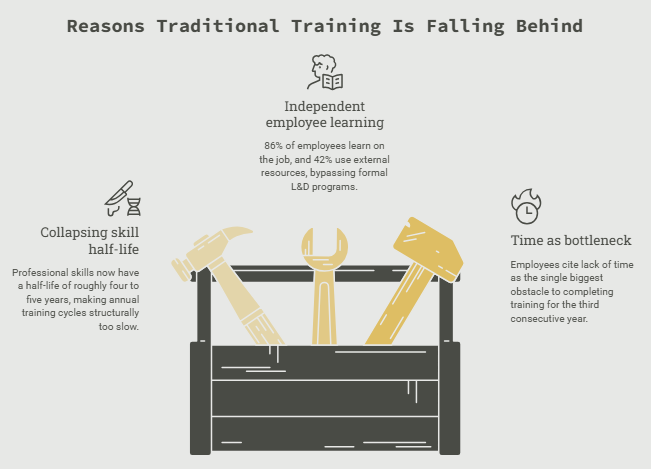
The working life of a professional skill used to be measured in careers. Research now puts the half-life of professional skills at roughly four to five years, and shrinking, according to World Economic Forum data. An annual training cycle built to refresh knowledge once a year is structurally too slow for a skill that’s already half-obsolete within that window.
Employees are already learning on their own — just not through L&D
This is the part that should concern every training leader most. In the latest TalentLMS workplace learning research, 86% of employees report that they pick up new skills or knowledge simply by figuring things out on the job, not through formal programs. A further 42% turn to external resources like online courses to close gaps their employer hasn’t addressed. The learning is happening. It’s just happening around L&D, not because of it.
Time, not motivation, is the real bottleneck
For the third consecutive year, employees cite lack of time as the single biggest obstacle to completing training. This isn’t an engagement problem that a better learning management system will fix. It’s a structural conflict: formal training asks people to step out of the flow of their work at exactly the moment their workload makes that hardest.
How Ready Is Your Organization for Transformation, Really?
Take our free 4-minute assessment and get a personalized report on your leadership fluency, governance, and workforce readiness.
Take the Free AI Readiness Assessment →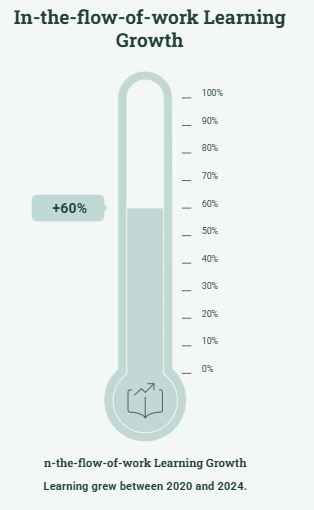
Source: linkedin
Did You Know?
In-the-flow-of-work learning grew 60% between 2020 and 2024, according to LinkedIn Learning data — making it one of the fastest-growing categories in corporate L&D even before generative AI accelerated the trend further.
How Does Flow-of-Work Learning Actually Work?
At a practical level, three things distinguish flow-of-work learning from a traditional course library:
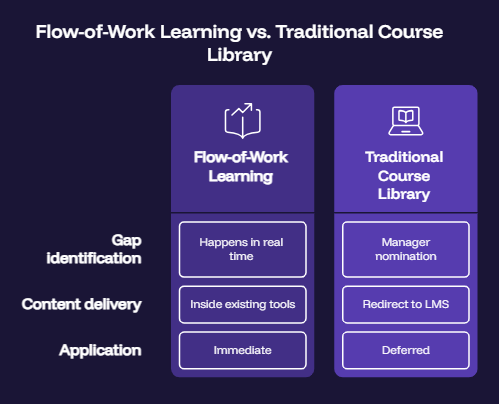
1. Gap identification happens in real time
Rather than a manager nominating someone for a course, AI-enabled systems increasingly monitor task patterns and surface a specific skill gap the moment it shows up in performance — a rep who consistently loses deals at the negotiation stage, a manager whose 1:1s never touch on career development.
2. Content arrives inside the existing tool
Instead of redirecting an employee to an LMS, the learning nudge, prompt, or short module appears inside the CRM, the ticketing system, or the collaboration tool the employee is already using.
3. Application is immediate, not deferred
Because the learning moment and the work moment are the same moment, there’s no gap between “I learned this” and “I used this” — which is precisely the gap that causes most formal training to evaporate within weeks.
Coaching has become one of the fastest-scaling formats for this reason: it’s inherently embedded in real work rather than delivered as a standalone event, and organizations are investing accordingly.
Does Flow-of-Work Learning Replace Formal Training Entirely?
No — and this is the distinction most organizations get wrong when they first hear about the shift. Flow-of-work learning is not a replacement for structured development; it’s a complement that handles a different job.
Formal training remains the right vehicle for foundational knowledge, regulatory or compliance requirements, and deep skill-building that benefits from sustained, uninterrupted focus — a new manager learning performance-conversation frameworks, for instance, genuinely benefits from a dedicated session rather than a fragmented, task-triggered nudge. Flow-of-work learning is the right vehicle for application, reinforcement, and just-in-time gap-closing.
The organizations getting this right aren’t choosing one model over the other. They’re using formal training to build the foundation and flow-of-work learning to keep it current, applied, and measurable.
Traditional Training vs. Flow-of-Work Learning
Dimension | Traditional Training | Learning in the Flow of Work |
Delivery timing | Scheduled, often annual or quarterly | Continuous, triggered by real-time need |
Location | Separate LMS or classroom | Embedded in the tools employees already use |
Gap identification | Manager nomination or self-selection | AI-driven, based on observed task performance |
Content format | Long-form courses, multi-day workshops | Microlearning, in-context nudges, coaching |
Measurement | Completion rates, satisfaction scores | Skill application, performance and productivity impact |
Best suited for | Foundational knowledge, compliance, deep frameworks | Reinforcement, application, fast-changing skills |
The Organizational Transformation Checklist Free guide, instant download.
Get the Guide →What’s the Business Case for Making the Shift?
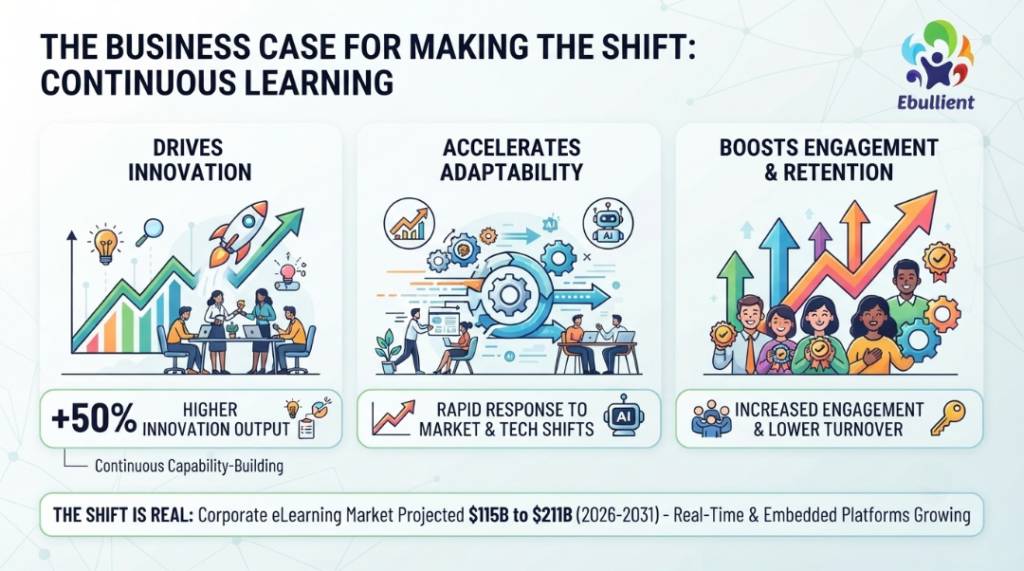
The case isn’t just about employee preference — it’s increasingly measurable in business terms.
Organizations with continuous-learning cultures show more than 50% higher innovation output than those without, according to McKinsey research. That’s not a training metric; it’s a business outcome. When capability-building is continuous rather than episodic, organizations adapt to market and technology shifts faster because the workforce isn’t waiting for the next scheduled refresh cycle to catch up.
The market is already voting with its budget. The global corporate eLearning market is valued at roughly $115.7 billion in 2026 and is projected to reach $211.8 billion by 2031, according to Mordor Intelligence, and more than 70% of L&D teams now use AI somewhere in their eLearning workflow. That growth is concentrated disproportionately in tools and platforms built for embedded, real-time delivery — not in traditional course catalogs.
There’s also a retention and engagement dimension. Employees who see their organization investing in continuously relevant development are more likely to stay and more likely to report that training positively affects how engaged they feel at work. In a labor market where skills — not tenure — increasingly determine internal mobility, an organization’s ability to keep pace with skill decay becomes a competitiveness question, not just an HR one.
How Should L&D Leaders Start Making the Shift?
Moving to flow-of-work learning doesn’t require ripping out an LMS or launching a massive AI platform on day one. A practical starting sequence looks like this:
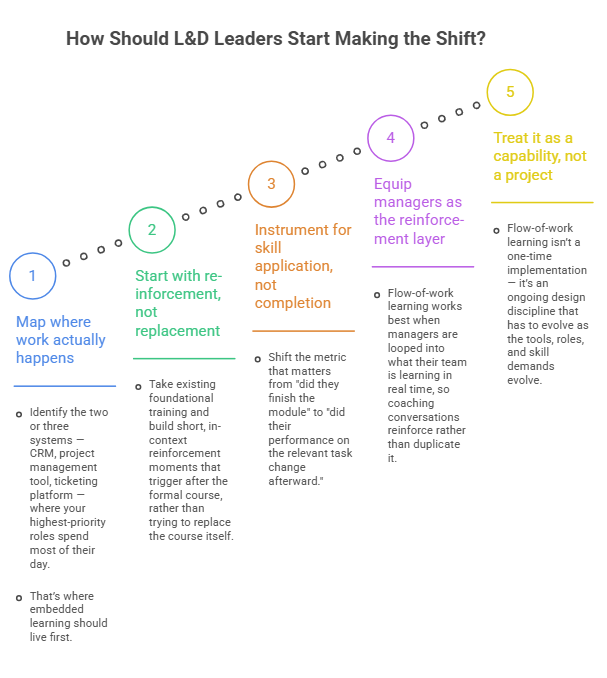
1. Map where work actually happens
Identify the two or three systems — CRM, project management tool, ticketing platform — where your highest-priority roles spend most of their day. That’s where embedded learning should live first.
2. Start with reinforcement, not replacement.
Take existing foundational training and build short, in-context reinforcement moments that trigger after the formal course, rather than trying to replace the course itself.
3. Instrument for skill application, not completion
Shift the metric that matters from “did they finish the module” to “did their performance on the relevant task change afterward.”
4. Equip managers as the reinforcement layer
Flow-of-work learning works best when managers are looped into what their team is learning in real time, so coaching conversations reinforce rather than duplicate it.
5. Treat it as a capability, not a project
Flow-of-work learning isn’t a one-time implementation — it’s an ongoing design discipline that has to evolve as the tools, roles, and skill demands evolve.
Curious About Other Areas of Your Organization?
Explore our other free assessments and get a fuller picture of where you stand.
View All AssessmentsHow Ebullient Can Help?
Ebullient Consultancy builds flow-of-work learning strategies for organizations that have outgrown the annual-training-calendar model but haven’t yet redesigned how learning fits inside daily work. Our approach starts with the task-friction audit described above, moves through manager-capability building — because reinforcement, not content, is usually the missing piece — and ends with a measurement framework tied to business outcomes rather than completion rates.
For HR and L&D leaders evaluating AI-driven training tools, Ebullient Consultancy also provides vendor-neutral guidance on where an LXP genuinely fits your workflow and where it will simply become another underused platform.
Final Thoughts
Traditional training isn’t disappearing, and it shouldn’t. Structured onboarding, regulated compliance content, and foundational skill-building still need dedicated time away from daily tasks. But treating that model as the whole strategy leaves most of an employee’s actual learning to chance, informal channels, and trial and error.
Learning in the flow of work closes that gap by putting the right guidance in the right task at the right moment, backed by managers who know how to reinforce it. Organizations that make this shift deliberately — rather than bolting a new platform onto an unchanged workflow — are the ones seeing measurable gains in ramp time, error reduction, and retention.
Want to meet the team?
Start with a 30-min conversation. No commitment needed.
Frequently Asked Questions
What is learning in the flow of work in simple terms?
It’s training delivered right inside the task an employee is already doing, through little prompts, checklists, or coaching, rather than as a separate class or course, so the guidance shows up right when it is needed.
Is learning in the flow of work the same as microlearning?
Not exactly. Microlearning refers to short-form content; flow-of-work learning refers to where and when that content is delivered — typically inside the employee’s existing workflow, often triggered by a real-time skill gap.
Does flow-of-work learning replace classroom or formal training?
No. Formal training remains the better format for foundational knowledge, compliance, and deep frameworks. Flow-of-work learning is best suited to reinforcement, application, and fast-changing skills.
How do organizations measure the impact of flow-of-work learning?
The most reliable measures shift away from completion rates and toward skill application — whether performance on the relevant task actually improves — along with downstream business metrics like productivity, quality, and retention.
What’s the first step for an organization wanting to adopt this model?
Identify the two or three systems where your priority roles spend most of their working day, and start embedding short, targeted reinforcement there — rather than attempting a full L&D redesign at once.