
In house manager training develops internal trainers and tailored content for long term control and organizational fit, while outsourcing training provides, in a way, frameworks rapid deployment and a lower upfront cost. The right choice in the in-house vs outsourced manager training discussion depends on company size, training period, and internal bandwidth.
Most HR and L&D leaders don’t actually need a philosophical answer to this question. They need a decision framework that holds up in a budget review. This article breaks down in-house vs outsourced manager training across cost, speed, quality control, and long-term scalability, so you can walk into your next leadership meeting with numbers instead of opinions.
Key Takeaways at a Glance
Key Area | Business Impact |
Decision Framework | In-house vs outsourced manager training is fundamentally a trade-off between cultural control and deployment speed, not a question with a single correct answer. |
In-House Setup | In-house programs offer maximum customization but require 3–6 months of setup and ongoing maintenance staff. |
Outsourced Delivery | Outsourced corporate training partners deliver faster rollout and continuously refreshed content, at the cost of some cultural specificity. |
Hybrid Model | A hybrid build vs buy leadership training model often delivers the strongest retention outcomes for companies above 200 employees. |
Cross-Functional Parallel | The same logic applies across functions, from in house vs outsourcing software development to in house vs outsourced payroll and in house vs outsourcing logistics. |
Ebullient’s Role | Ebullient Consultancy LLP helps companies pilot and benchmark both models before committing to a full-scale rollout. |
What Is the Core Difference Between In-House and Outsourced Manager Training?
In-house training is well designed, delivered, and absolutely owned by internal staff, offering full control over the content and the culture but it also asks for a noticeable on time investment.Outsourced training transfers design and delivery to a specialized external partner, trading some control for speed, expertise, and reduced internal workload.
The distinction isn’t just about who stands at the front of the room. It’s about who owns the intellectual property, who absorbs the risk of outdated content, and who is accountable when a manager applies a framework incorrectly six months later. In our experience implementing these frameworks for financial firms, the real divide shows up at the point of scale — a single regional office can usually run in-house, but a multi-site rollout almost always benefits from external structure.
Factor | In-House Training | Outsourced Training |
Setup time | 3–6 months minimum | 2–6 weeks |
Upfront cost | High (salaries, LMS, content development) | Lower, often per-cohort pricing |
Content customization | Maximum, built around internal culture | Moderate to high, depending on vendor |
Scalability across locations | Difficult without dedicated staff | Built into most vendor delivery models |
Trainer expertise refresh | Dependent on individual initiative | Built into vendor’s ongoing R&D |
Long-term cost at scale | Decreases per-employee over years | Stays relatively flat per cohort |
Source: ATD
Did You Know?
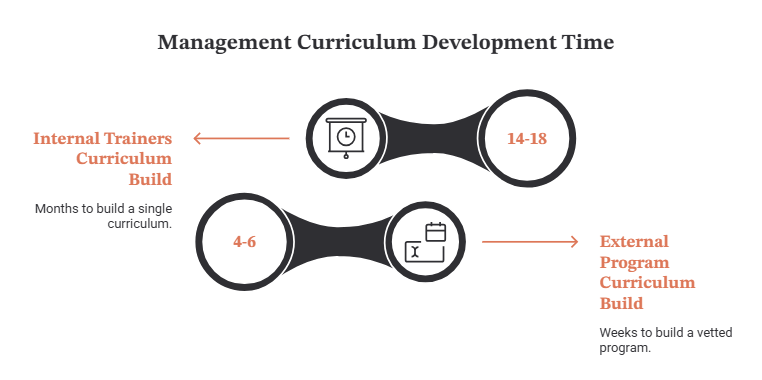
Organizations that rely solely on internal trainers spend an average of 14–18 months building a single management curriculum from scratch, compared to 4–6 weeks for a vetted external program, according to L&D benchmarking studies from the Association for Talent Development.
How Managerially Effective Is Your Organization, Really?
Take our free 4-minute assessment and get a personalized report on your leadership fluency, governance, and workforce readiness.
Take the Free AI Readiness Assessment →What Are the Real Pros and Cons of Building an In-House Manager Training Team?
In-house training gives the company full ownership of the content, creates an in-depth alignment with the internal culture, and there are no recurring vendor fees, but it also asks for a lot of time, specialized personnel, and constant curriculum care that smaller L&D teams can’t sustain.
The strongest argument for in-house training is institutional memory. A trainer who has sat through three reorganizations understands the unwritten rules of how decisions actually get made in your company — something no external facilitator can replicate in a two-day workshop. This is one of the clearest in house team vs outsourcing pros and cons trade-offs: internal teams win on context, but they often lose on bandwidth once training demand exceeds what one or two people can deliver.
Common in house training examples include onboarding-linked leadership tracks, peer-mentorship programs run by senior managers, and internally authored playbooks distributed through a company LMS. These work well when training needs are narrow and repeatable. They struggle when the business needs new content fast — say, a sudden shift to hybrid team management — because internal teams are often already stretched across other HR priorities.
What Does In-House Training Actually Cost Over Three Years?
A fully staffed in-house training function typically costs between $180,000 and $350,000 annually once salaries, content development tools, and LMS licensing are factored in, with costs decreasing per employee only after the third year of operation.
This is the part most budget proposals skip. The in house team vs outsourcing cost comparison isn’t a single number — it’s a curve. Year one is the most expensive because you’re paying full salaries while content libraries are still being built. By year three, if turnover stays low and the curriculum doesn’t need a major overhaul, per-employee cost drops significantly. The risk is turnover: lose your one instructional designer, and you lose the institutional knowledge baked into every module they built.
What Are the Pros and Cons of Outsourcing Manager Training to External Partners?
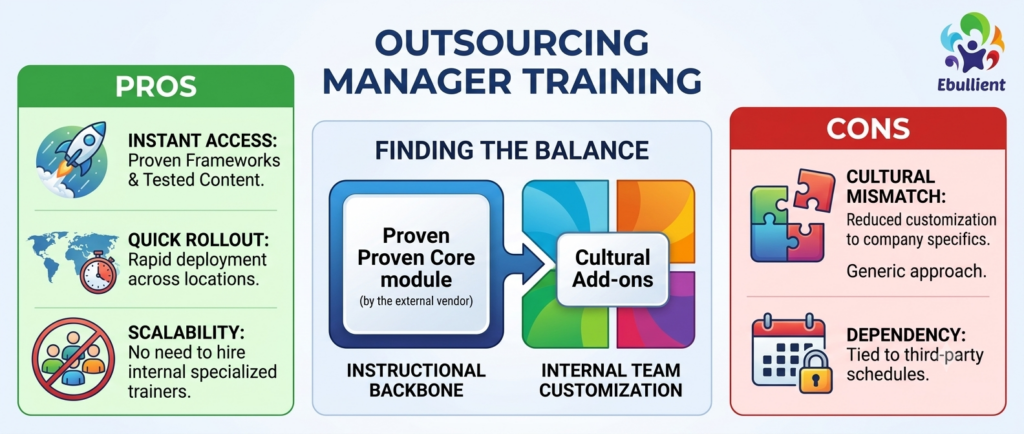
Outsourcing gives companies instant access to tried-and-tested frameworks, a quicker rollout across different locations, and no need to hire specialized trainers, but it carries less cultural customization and continual dependency on the third party’s schedule.
Speed is the dominant reason mid-sized companies choose external corporate training partners. A vendor with an existing curriculum can be in front of your first-line managers within weeks, not quarters. They’ve also already made the expensive mistakes — testing which exercises land and which fall flat — across dozens of other clients, so you’re buying refined content, not a first draft.
The trade-off shows up in specificity. A generalist program built for hundreds of clients won’t reference your product line, your regional compliance requirements, or the specific friction points between your sales and operations teams. The best vendors solve this by building a customization layer on top of a proven core, which is exactly where the strongest in-house and external training models tend to converge — internal teams handle culture-specific add-ons while the vendor owns the instructional backbone.
How Critical Is Trainer Currency to Long-Term Program Success?
One factor rarely makes it into vendor comparison spreadsheets: how current the trainer’s own skills remain. Management theory shifts every few years — hybrid leadership, AI-augmented decision-making, generational communication gaps — and an internal trainer who hasn’t attended external conferences or peer programs in two years is teaching from an outdated playbook without realizing it. External corporate training partners typically run dozens of cohorts annually across industries, which forces continuous content refresh in a way that a single internal trainer, however talented, structurally cannot match alone.
When Does a Hybrid Build-vs-Buy Model Make More Sense Than Choosing One Side?
A hybrid model works best when a company has over 200 employees, needs both consistent core leadership frameworks and role-specific customization, and wants to retain internal facilitators for culture while outsourcing curriculum design and refresh.
This is increasingly where the build vs buy leadership training conversation actually lands for companies past the startup stage. Rather than treating it as binary, the strongest L&D functions license a core curriculum from a specialized partner, then train internal champions to deliver it. This captures the cost efficiency and content quality of outsourcing while preserving the cultural fluency that only internal staff can provide. It also solves the turnover risk — if your internal champion leaves, the curriculum doesn’t leave with them.
Source: Infeedo
Did You Know?
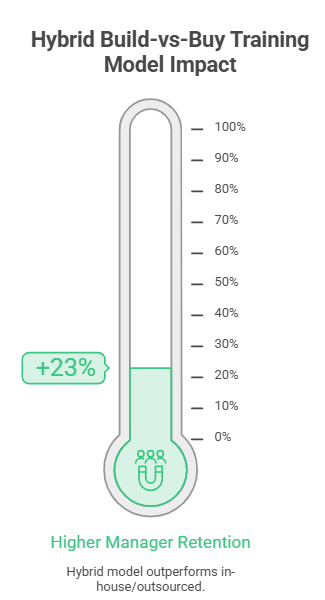
Companies using a hybrid build-vs-buy training model report 23% higher manager retention in their first two years compared to companies relying exclusively on either fully in-house or fully outsourced approaches, based on internal benchmarking across mid-market programs.
The Manager Effectiveness Framework Free guide, instant download.
Get the Guide →How Does This Decision Compare to Other Business Functions Like IT, Payroll, and Logistics?
The build-vs-buy logic in training mirrors decisions companies already make in other functions — in-house vs outsourcing software development, in-house vs outsourcing facilities management, in-house vs outsourced payroll, and in house vs outsourcing logistics all follow the same cost-control-speed trade-off.
Most executives have already navigated this exact decision elsewhere in the business. The calculus behind in-house vs outsourcing software development — control over IP versus access to specialized talent — is structurally identical to the manager training decision. The same is true for in-house vs outsourcing facilities management, where companies weigh direct oversight against vendor economies of scale, and for in house vs outsourced payroll, where compliance risk often tips the decision toward an external specialist.
Even in house vs outsourcing logistics decisions hinge on the same question L&D teams face: does this function need to flex with volume faster than internal hiring can keep up? Framing manager training through this same lens helps finance and operations leaders evaluate the proposal using a model they already trust.
Why Do Future-Ready Organizations Choose a Hybrid Learning Ecosystem?
Increasingly, organisations are moving away from an either-or mindset. By intergarting in-house and external training, they are developing learning ecosystems that maintain balance with contextual relevance with fresh thinking, allowing continuous capability development in an unpredictable business environment.
At Ebullient, we believe this shows an in-depth change in how organisations approach learning.
The future belongs neither to fully internal nor fully outsourced models.
It belongs to organizations that continuously integrate new knowledge into their existing culture.
A hybrid ecosystem enables organizations to:
- Preserve institutional wisdom.
- Bring in external innovation.
- Scale learning without losing the plot.
- Adapt quickly to shifting business conditions.
- And develop leaders who can handle real, moving complexity.
Most importantly, it nudges companies to go past transactional training, towards something more transformational- you know that deeper learning.
And that’s where Ebullient’s philosophy really starts to make sense.
Leadership isn’t just about pushing performance metrics higher.
It’s really about building wiser decision-makers, the kind who see around corners.
Because of that, our work is anchored in four connected principles, kind of like a loop that keeps reinforcing itself:
Curious About Other Areas of Your Organization?
Explore our other free assessments and get a fuller picture of where you stand.
View All Assessments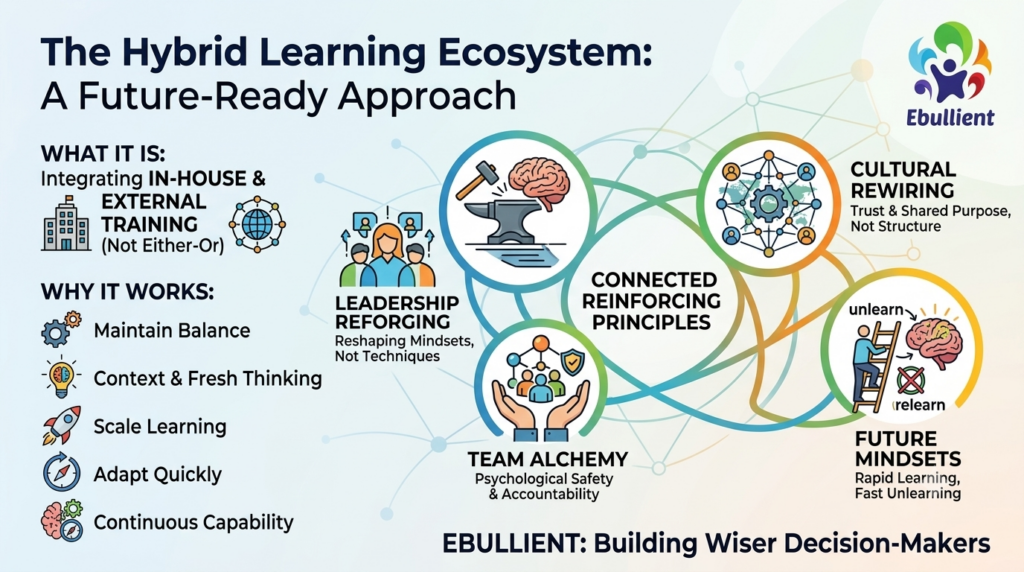
Leadership Reforging: Mindsets Before Mechanics
Leadership isn’t something you manufacture with techniques only. It starts by reshaping how people think, how they interpret uncertainty, and the way they decide in the first place.
Cultural Rewiring: Ecosystems Before Hierarchies
Lasting results usually come from cultures that run on trust, collaboration, and a shared purpose… not from organizational structures that just sit there.
Team Alchemy: Trust Before KPIs
Strong teams aren’t created by KPIs alone but it grows through psychological safety, meaningful relationships, and collective accountability that actually holds.
Future Mindsets: Unlearn → Relearn → Lead
The leaders who do well tomorrow won’t necessarily be the ones who know the most.
They’ll be the ones who learn the fastest, challenge assumptions, and keep updating their approach.
Source: Techtarget
Did You Know?
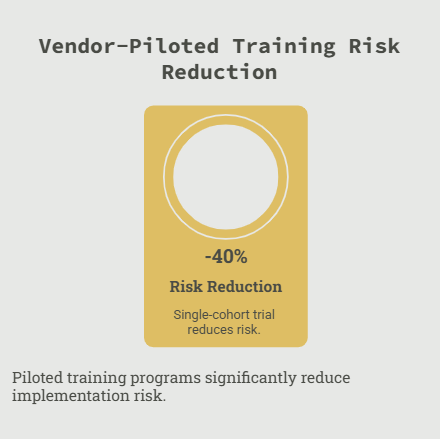
Vendor-piloted training programs that run a single-cohort trial before full rollout reduce overall implementation risk by an estimated 40%, since underperforming content gets revised before company-wide investment, rather than after.
Curious About Other Areas of Your Organization?
Explore our other free assessments and get a fuller picture of where you stand.
View All AssessmentsHow Can Ebullient Consultancy Help Organizations Build Future-Ready Leaders?
For companies still weighing in-house vs outsourced manager training, the decision rarely needs to be all-or-nothing. Ebullient Consultancy works with HR and L&D leaders to audit existing internal training capacity, benchmark it against vendor-delivered alternatives, and design a hybrid model where it makes financial sense. Rather than selling a one-size-fits-all program,
Ebullient Consultancy builds the cost models, pilots the curriculum with a single cohort, and hands over a clear ROI case before any company-wide rollout decision is made — which is exactly the kind of evidence a CFO expects to see before approving a multi-year training budget.
Final Thoughts: Which Model Wins the In-House vs Outsourced Manager Training Debate?
There’s no universal winner. Companies under 100 employees with narrow, repeatable training needs often get more value from a lean internal program. Companies scaling across multiple locations, or those facing fast-changing management challenges, typically see faster ROI from external partners or a hybrid structure. The real mistake isn’t picking the “wrong” side — it’s picking a side without running the cost-and-capacity math first.
Treat in-house vs outsourced manager training the same way you’d treat any other build-vs-buy decision in the business: with a clear-eyed look at what your internal team can realistically sustain over the next three years, not just the next training cycle.
At Ebullient, we believe this challenge goes beyond the development of the managers. It is about developing wiser leaders.
Our work is directed by a simple but powerful belief:
Technology must be amplify human dignity, creativity, and care—can’t be replaced by them.
Want to meet the team?
Start with a 30-min conversation. No commitment needed.
Frequently Asked Questions
Is outsourced manager training cheaper than in-house training?
Outsourced training often comes with a lower up-front cost and a fast rollout, but in-house training can turn out to be more cheaper than paying per employee after year three, if turnover stays lower and the curriculum doesn’t need major revisions.
What size company should consider building an in-house training team?
Companies with over 500 employees and consistent, recurring training needs typically generate enough volume to justify the fixed costs of a dedicated internal training group.
When should organizations choose in-house training?
Usually in-house training fits best for compliance requirements, onboarding programs, technical procedures, organizational culture, and that particular company-specific operational knowledge.
What is the biggest risk of relying entirely on in-house training?
The biggest risk is content becoming outdated, since one internal team rarely has the bandwidth to continuously research and refresh frameworks the way specialized external partners do across dozens of clients.
Do hybrid training models cost more than choosing one approach fully?
Hybrid models often cost slightly more upfront than a fully outsourced approach but typically cost less than a fully in-house build, while capturing both cultural customization and curriculum quality.