
Change management in practice is a systematic process that builds employees, leaders, and teams to execute organisational changes. The change management supports organisations in avoiding resistance, increasing employee engagement, accelerating the adoption cycle, and achieving transformational shift through effective communication, leadership readiness, continuous training, and ongoing support.
Today, effective transformation depends not only on systems and strategy but also on an organisation’s capability to prepare teams for adaptability, emotionally intelligent leadership readiness, and organisational cultures capable of thriving under ambiguity.
Key Takeaways – At a Glance
- Change management in practice primarily focuses on systematic employee adoption during organisational transformation.
- The 7 steps of change management boost organisations to execute sustainable change effectively.
- The team leads work to decrease employee opposition while they create environments which encourage staff members to participate.
- Current change management systems focus on improving employee experience while supporting continual development.
- The optimal change management framework for organizations needs to combine several different models to achieve proper organizational alignment.
- Success of Change Management in 2026 requires organizations to develop their agility capabilities and implement their analytics systems and AI technologies and employee adaptability skills.
What Is Change Management in Practice?
Change management in practice refers to applying structured methods, leadership strategies, communication plans, and employee engagement techniques to help teams transition successfully during organizational changes. It revolves around strategic business decisions that turn into actionable workforce adoption processes that reduce disruption and enhance long-term operational results.
The concept of change management goes far beyond initiating a new policy or executing new software. Organisations today face ongoing disruption from AI adoption and hybrid work to remodel and digital transformation. Team leads now need active participants in transformation initiatives. They are operational drivers of workforce transformation.
Here’s the reality for L&D teams: employees hardly resist change because they hate innovation. Mostly resistance comes from uncertainty, lack of communication gap, unclear thoughts, or fear of failure.
This is why change management in practice plays an essential role for modern organisations. Businesses that invest in effective change in management frameworks often gain:
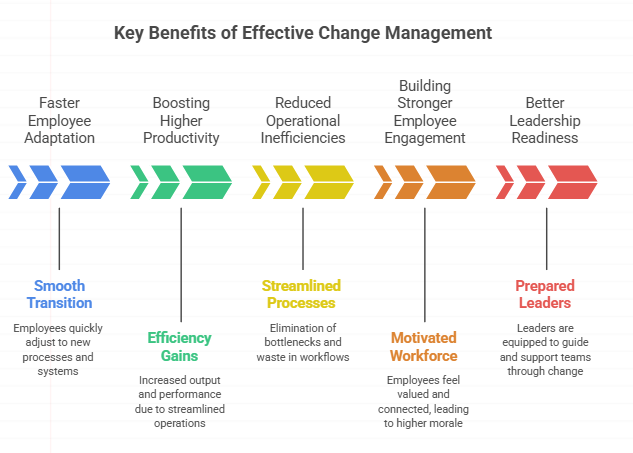
- Faster employee adaptation
- Boosting higher productivity
- Reduced operational inefficiencies
- Building Stronger Employee Engagement
- Better leadership readiness
The importance of change management in practice becomes even clearer during enterprise-level transitions. Without any structured planning, even technically robust transformation projects may fail due to human resistance.
How Managerially Effective Is Your Organization, Really?
Take our free 4-minute assessment and get a personalized report on your leadership fluency, governance, and workforce readiness.
Take the Free AI Readiness Assessment →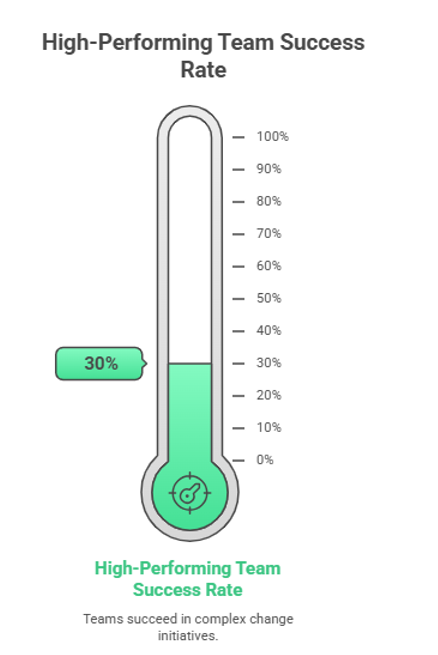
Source: McKinsey
Do You Know?
According to McKinsey’s research studies, a high-performing team is hypothesised to succeed in only about 30 per cent of the complex change initiatives.
Why Does Change Management Fail in Organizations?
One of the biggest misunderstandings surrounding the change management process is that employees undertake to incorporate leadership announcements of change.
But resistance hardly starts where leaders are expected.
Employees typically struggle with:
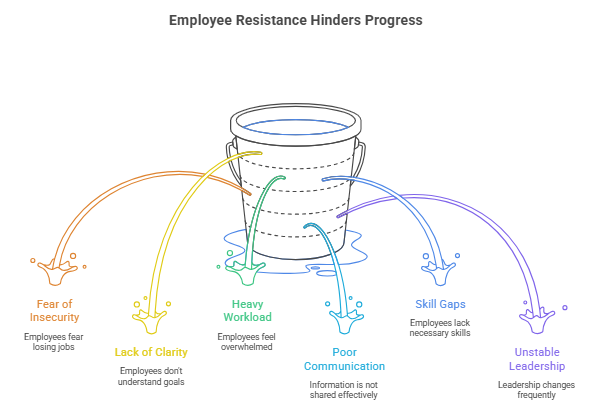
- Fear of job insecurity
- Lack of clarity
- heavy workload
- Poor communication
- Skill gaps
- unstable leadership
Common Reasons Change Initiatives Fail
| Failure Factor | Organizational Impact |
|---|---|
| Poor communication | Employee confusion and disengagement |
| Lack of leadership alignment | Mixed messaging across teams |
| No employee involvement | Increased resistance |
| Inadequate training | Low adoption rates |
| Unrealistic timelines | Operational burnout |
| Weak reinforcement | Employees revert to old habits |
The importance of change management in practice is feasible when organisations proactively address these barriers before turn out.
For example, during ERP implementation projects, many companies underrated the emotional stress positioned on frontline employees. Productivity often drops down because employees fail to adopt the technology, but because they lack confidence and knowledge while using it.
This is where practical leadership intervention proceeds.
What Are the 7 Steps of Change Management?
The 7 steps of change management offers a systematic roadmap for planning, implementing, and supports in achieving organisational transformation. These steps help leaders to reduce uncertainty, enhance communication, supports in adoption, and ensure employees transition effectively through operational and cultural changes.
The 7 Steps of Change Management
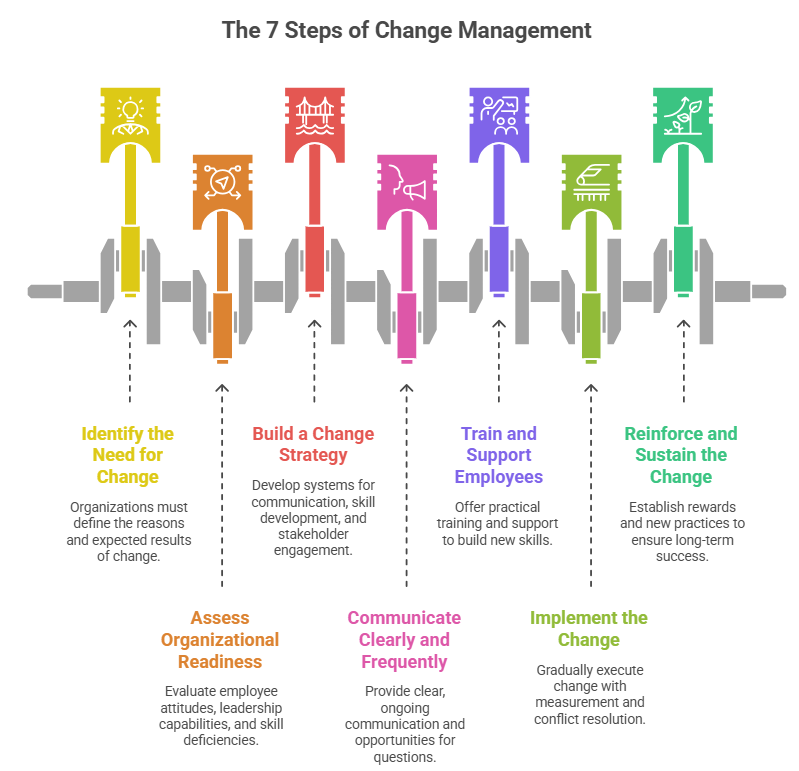
1. Identify the Need for Change
Organizations must define:
- The reasons that make change necessary.
- The specific business problem that needs a solution.
- The expected results that will occur after the change.
The employees need to understand the purpose of the transformation because they lack understanding without urgency.
2. Assess Organizational Readiness
Evaluate:
- The current employee attitude.
- The current state of leadership capabilities.
- The existing skill deficiencies.
- The existing operational requirements.
The process identifies risks at an early stage, which helps improve the entire change management system.
3. Build a Change Strategy
The development team must create:
- A system to communicate with others.
- A framework to develop employee skills.
- A system to engage different stakeholders.
- A system to measure results.
The organization needs to establish effective change management procedures that connect its business objectives with actual employee working conditions.
4. Communicate Clearly and Frequently
This represents the main point where organizations encounter their most significant challenges.
Employees need:
- Clear information about the organization.
- The organization should provide ongoing communication from its leaders.
- The organization should give employees chances to ask questions.
- The organization should provide employees with information about their work progress.
5. Train and Support Employees
Successful change management in practice requires practical capability-building—not just awareness sessions.
Training should include:
- Learning that applies to specific job functions.
- Practical experience through direct involvement.
- Learning from colleagues who have more experience.
- Instruction from organizational leaders.
6. Implement the Change
The organization needs to implement change through its process, which requires both measurement and gradual execution.
Leaders should:
- Observe how people adopt new behaviors.
- They need to resolve any conflicts that arise between users.
- They must create systems that enable users to provide their opinions.
- They need to observe how people behave over time.
7. Reinforce and Sustain the Change
Long-term success depends on sustainability.
Organizations must:
- Establish rewards for people who use new systems.
- They need to evaluate how their actions affect the overall performance.
- They need to maintain their communication efforts.
- The organization needs to establish new practices which employees will follow as their new normal.
Source: Wiley
Did You Know?
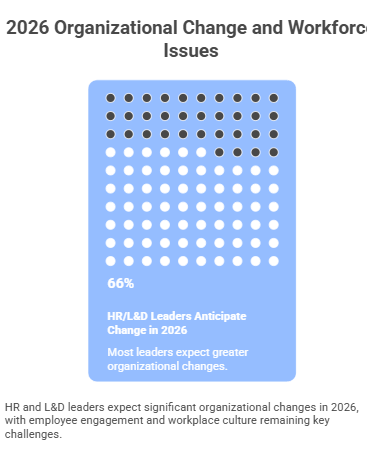
Research from Wiley Workplace Intelligence discovered that 66% of HR and L&D leaders anticipate greater organizational changes which will occur during 2026 while employee engagement and workplace culture stay as the primary workforce issues that organizations face during their transformation processes.
Which Change Management Models Work Best?
Different change management models work best depends upon the organisational culture, leadership alignment, workforce challenges, and transformation initiatives. The most effective models integrate communication, employee engagement, leadership readiness, and behavioral reinforcement.
Not every organization needs the same approach.
Popular Change Management Models
| Model | Best Use Case | Key Strength |
|---|---|---|
| Kotter’s 8-Step Model | Large-scale transformation | Leadership-driven urgency |
| ADKAR Model | Employee adoption | Individual behavior focus |
| Lewin’s Change Model | Process restructuring | Simplicity and clarity |
| McKinsey 7-S Framework | Organizational alignment | Strategic coordination |
| Bridges Transition Model | Emotional adaptation | Employee psychology focus |
Many organisations seeking for the best change management framework that combines multiple models instead of adopting one rigid methodology.
For instance:
- ADKAR supports with employee adoption
- Kotter builds leadership-driven transformation
- McKinsey enhances organizational alignment
This blended approach is becoming increasingly important for Change Management in 2026 initiatives where organizations must balance operational execution with human-centered adaptation.
Why Traditional Change Management Models Are Breaking Down in 2026?
Traditional change management models established a framework for organizations which operated in stable business conditions. The current business environment requires organizations to deal with ongoing disruptions which create emotional and unpredictable changes that last indefinitely.
The complete leadership structure experiences a fundamental shift through this development.
Today’s organizations encounter multiple challenges which include:
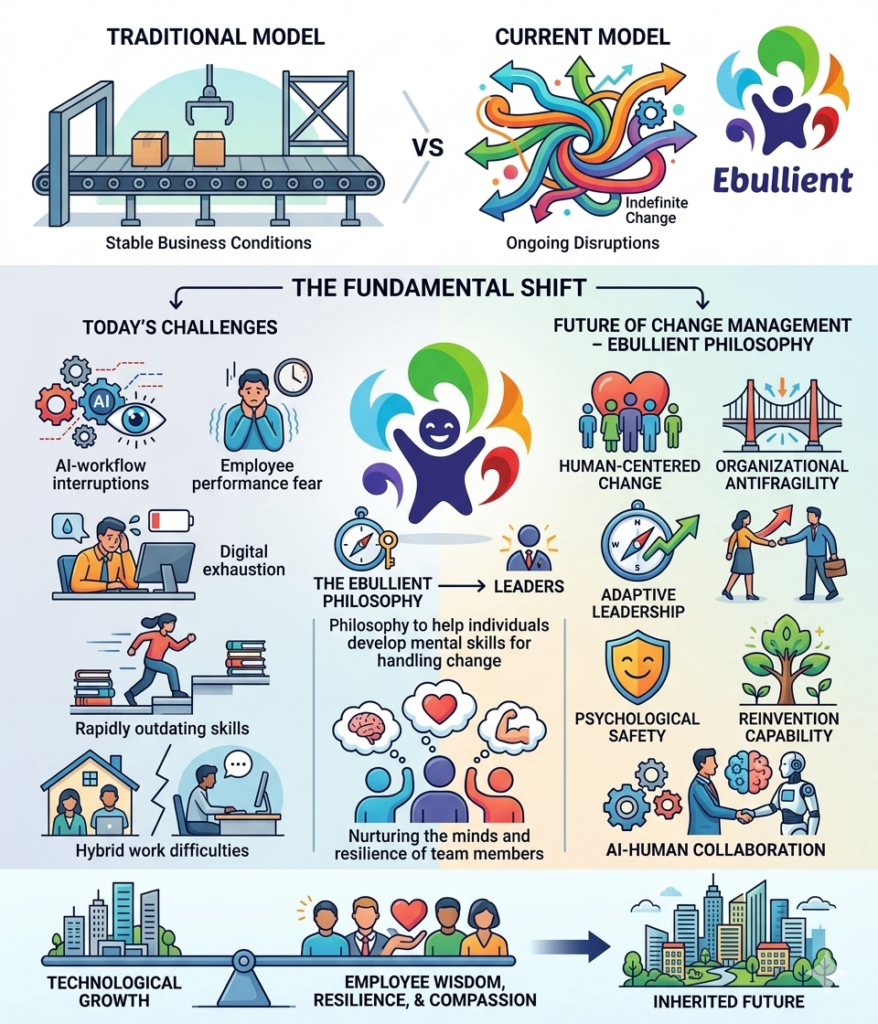
- AI-based workflow interruptions
- Employee performance fear
- Workers experience digital exhaustion
- Organizations keep developing new business strategies
- Teams face difficulties in hybrid work environments
- Employees see their work skills become outdated at an increasing rate
The future of change management will not be defined by how quickly organizations implement technology.
The primary factor that determines success in managing change exists through leaders who assist individuals in developing mental skills for handling ongoing changes.
The Ebullient philosophy begins to play a vital role at this point.
Organizations need to adopt contemporary leadership methods to handle the rapid technological progress that exceeds industrial-age boundaries.
The current process of transformation requires three main components which include:
- Human-centered change
- Organizational antifragility
- Adaptive leadership
- Psychological safety during change
- Reinvention capability
- AI-human collaboration
Organizations that succeed in maintaining a balance between their technological growth and their employees’ wisdom, resilience, and compassion will inherit the future.
How Do Team Leads Drive Organizational Change?
Team leads play a vital role in organisational transformation because employees trusts managers more than executive announcements. Effective team leads translate strategic goals converts into daily operational tasks, which helps employees to adapt them with clarity, confidence, and accountability.
This is how change management in practice becomes operational.
Senior leadership maintains the power to change the transformation strategy, while team leads control the following activities:
- Daily communication
- Emotional reassurance
- Workflow adaptation
- Accountability
- Skill development
Key Responsibilities of Team Leads During Change
Communicate with Context
Employees want answers to practical questions:
- How does this affect my role?
- What changes daily?
- What support is available?
- Reduce Fear and Uncertainty
Strong leaders acknowledge employee concerns instead of dismissing them.
Monitor Employee Sentiment
Resistance often appears silently through:
- Low engagement
- Delayed responses
- Reduced collaboration
- Passive non-compliance
Reinforce Desired Behaviors
Sustainable transformation requires organizations to enforce behavior changes.
Change management and leadership need to be discussed because both fields require different approaches. Leadership creates a vision for the future. Change management operationalizes adoption.
What Are the Most Common Types of Change Management?
The main types of change management covers: strategic, structural, technological, cultural, and people-centric transformation initiatives. Each type needs different type of leadership framework, communication methods, and adoption strategies depending on Organizational intricacy and workforce impact.
Majorly 5 Types of Organisational Change are:
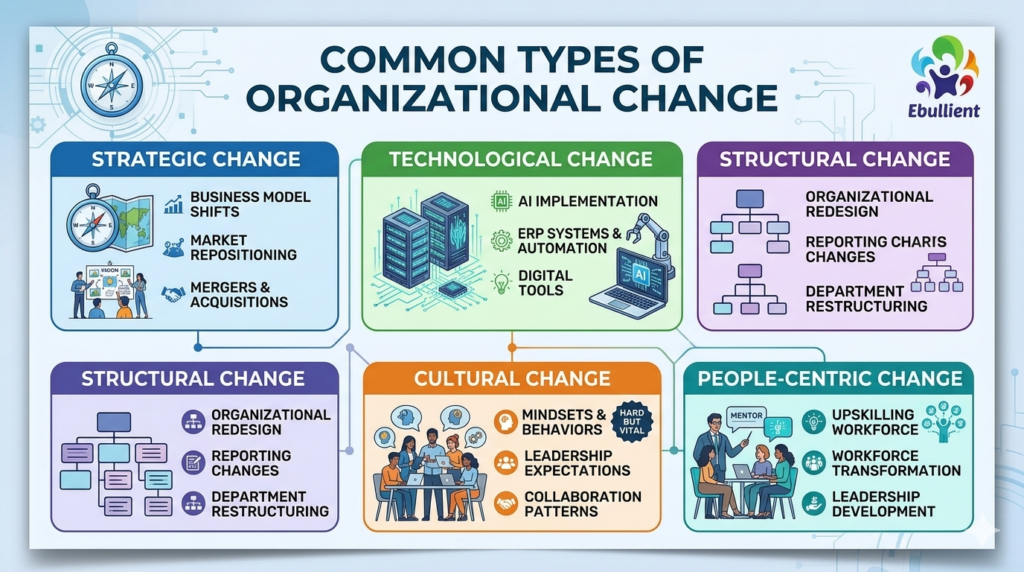
1. Strategic Change
The process requires:
- Business model shifts
- Market repositioning
- Mergers and acquisitions
2. Technological Change
The process includes:
- AI implementation
- ERP software systems
- Automation software platforms
- Digital office equipment
3. Structural Change
The field investigates:
- Organizational redesign
- Reporting changes
- Department restructuring
4. Cultural Change
The process represents one of the most difficult transitions for organizations.
The process requires organizations to change:
- Behaviors
- Mindsets
- Leadership expectations
- Collaboration patterns
5. People-Centric Change
The process of upskilling and workforce transformation, and leadership development make up the process. People-Centric Change
The types of change management chosen often determine the complexity of the overall transformation effort. The types of change management selected by organizations will create specific challenges for their transformation process.
Source: Deloitte
Did You Know?
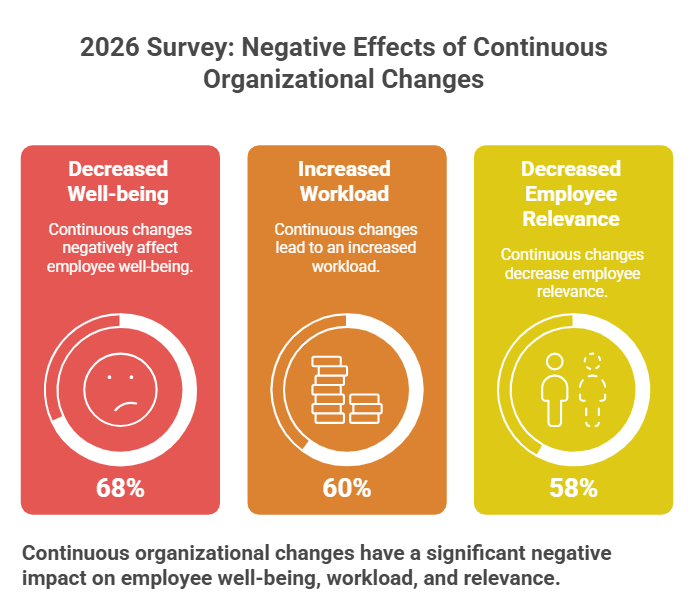
The 2026 survey found that continuous organizational changes have resulted in three negative effects, which include decreased well-being (68%), increased workload (60%), and decreased employee relevance (58%) of staff members.
What Are the Biggest Employee Resistance Challenges?
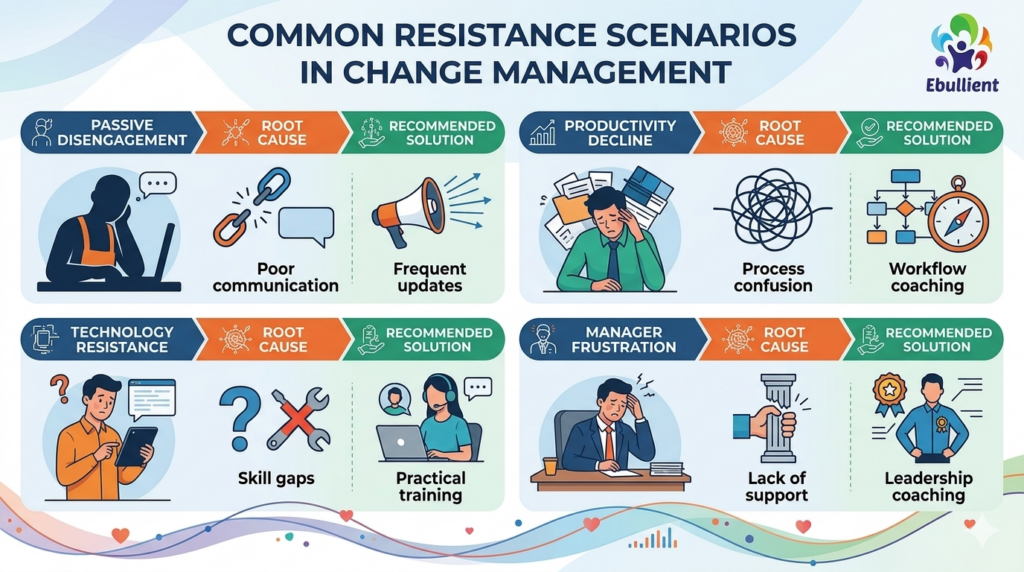
The main reason employees resist change is that they do not understand what will happen next, and they feel afraid that their abilities will become useless and they experience difficulty in understanding others and they face too much work and they do not trust their leaders to guide them. The main reason people oppose things is that they think those things will not succeed.
Employees develop concerns about five specific areas, which include job security, performance expectations, technology adaptation increased workload, and role clarity. Transparent communication stands as the fundamental requirement for successful change management.
The Manager Effectiveness Framework Free guide, instant download.
Get the Guide →What Is the Difference Between Change Management and Leadership?
The debate around change management vs leadership centers on execution versus influence. Leadership inspires people toward a vision, while change management, by offering a structured process, needs to execute and to achieve sustainable organizational transformation successfully.
Change Management vs Leadership
| Leadership | Change Management |
|---|---|
| Creates vision | Creates execution plans |
| Inspires employees | Guides adoption |
| Focuses on motivation | Focuses on process |
| Drives culture | Drives implementation |
| Encourages innovation | Reduces resistance |
Without leadership, change lacks inspiration.
Without structured change management strategies, transformation lacks sustainability.
What Are the Best Change Management Courses for Managers?
The best change management coursese supports managers to enhance leadership communication skills, boost employee engagement, conflict management, and transformation execution skills.
Highly impactful programs which include:
- Scenario-based learning
- Leadership simulations
- Organisational psychology
- Effective Communicator
- Employee engagement program
The most effective training programs focus on real world operational challenges instead of theoretical frameworks.
Organisations that are heavily investing on practical leadership development may often experience better adoption results during workplace transformation initiatives.
Curious About Other Areas of Your Organization?
Explore our other free assessments and get a fuller picture of where you stand.
View All AssessmentsHow Ebullient Helps Organizations Manage Change
Ebullient consultancy helps organisations to build workforce adaptability through leadership development, change readiness programs, employee engagement training, and transformation-aligned learning solutions tailored to modern business environments.
Technology transformation itself cannot creates the business transformation.
People do.
Ebullient helps in developing organisations through:
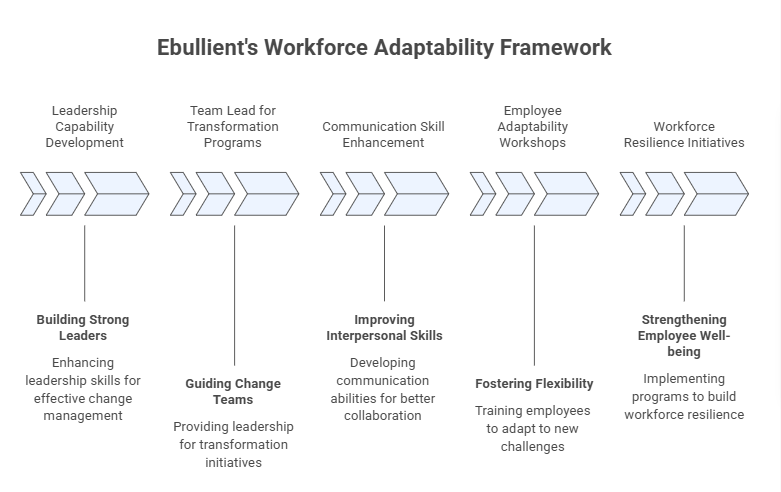
- Leadership capability development
- Team lead for transformation programs
- Communication skill enhancement
- Employee adaptability workshops
- Workforce resilience initiatives
In a world shaped by what many thinkers describe as “Palaeolithic emotions, medieval institutions, and godlike technology,” organizations need leaders capable of balancing technological acceleration with wisdom, adaptability, courage, and humanity.
As trends in organisational change management continue to evolve, organizations’ demands for learning partners that blend strategic insight with practical workforce execution.
Final Thoughts
Effective change management in practice helps in developing organisations to balance workforce confidence, operational continuity, and leadership alignment during periods of uncertainty.
The organisations that succeed over the next decade will not certainly be the ones with the most advanced technology. They will be the ones who prepare for adaptable teams, resilient leadership, and building transformation capability across every level of the business.
Want to meet the team?
Start with a 30-min conversation. No commitment needed.
Frequently Asked Questions
What is the concept of change management?
The process of change management uses organized procedures to assist organizations in moving their staff and operational activities and technological systems through their business change efforts. The method concentrates on four areas, which include communication and leadership connection, staff participation, and the process of developing new workplace habits.
What is the importance of change management for organizations?
The practice of change management holds great value because it helps organizations decrease employee resistance while their transformation initiatives proceed which results in higher adoption rates, ongoing productivity, and stronger organizational stability.
Which change management models serve as the most effective solutions for organizations?
ADKAR and Kotter’s 8-Step Model and Lewin’s Change Model, and McKinsey’s 7-S Framework represent popular change management models. The selection of an ideal model requires consideration of three factors which include organizational culture and workforce complexity and specific transformation objectives of the organization.
What distinguishes change management from leadership functions?
The discussion between change management and leadership shows how organizations use two different methods to achieve their goals. The process of leadership enables employees to pursue a shared organizational goal while change management establishes the necessary frameworks and procedures to achieve successful results.
What organizational change management methods are currently practiced by organizations?
The present organizational change management methods combine AI-driven transformation with leadership that focuses on employee experience together with agile learning ecosystems and hybrid workforce adaptation and systems for real-time employee sentiment assessment.