
In leadership conversations, efficiency (doing things right) and efficacy (doing the right things) are often positioned as though one must strictly precede the other. But in truth, the best corporate leaders know that efficacy must lead—and efficiency should follow—for sustained, meaningful impact.
Key Takeaways – At a Glance
- Efficacy vs. efficiency is about doing the right things before doing things right.
- The combination of efficacy with efficiency gives complete system failure.
- Leaders need to establish their primary focus on strategic objectives and organisational mission and team bonding.
- The practice of leadership shows how important it is to follow specific steps.
- Organisations need to find a balance between their need for effective operations and their demand for efficient systems.
Understanding Efficacy vs Efficiency in Leadership
‘Efficacy vs efficiency in leadership’ refers to doing the right things (efficacy) versus doing things right (efficiency). Efficacy functions to establish strategic relationships between objectives while efficiency supports the complete implementation of those objectives.
The primary focus of leadership is on efficiency because people can measure it through three specific metrics, which include cost reductions and production improvements and quicker project completion times. Leadership effectiveness centres on creating positive outcomes which include three essential elements: impact and outcomes and organisational relevance.
- Efficacy = Strategic correctness.
- Efficiency = Operational excellence.
A simple efficacy vs. efficiency example:
A company reduces training costs (efficient), but employee capability drops (ineffective). The result creates a situation which produces decreased productivity combined with increased expenses for an extended period.
The business needs to assess its efficiency levels for effective management operations. Leaders need to determine whether their current actions support business objectives before they begin to improve their performance.
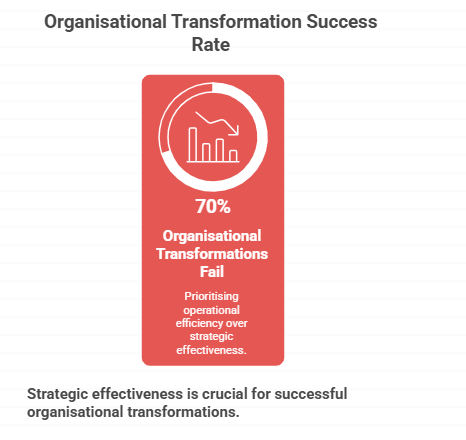
Source: McKinsey
Did You Know?
According to McKinsey, approximately 70% of organisational transformations fail because organisations prioritise operational efficiency instead of assessing their strategic effectiveness.
How AI-Ready Is Your Organization, Really?
Take our free 4-minute assessment and get a personalized report on your leadership fluency, governance, and workforce readiness.
Take the Free AI Readiness Assessment →Why must leaders prioritize efficacy before efficiency?
Leaders must first prioritise efficacy because it helps their organizations to achieve their mission and execute their strategic plan and create value for the upcoming years. Efficiency without efficacy leads to process optimization of incorrect methods which results in wasted work and improper outcomesThe establishment of clear direction enables organizations to achieve substantial results through their efficiency efforts.
Why Efficacy Must Come First
Efficiency—streamlining processes, cutting costs, getting more output with fewer inputs—is easy to measure and seductive. But without clarity of purpose and strategic direction, you risk being extremely efficient at the wrong things. Efficacy is choosing the right goals, aligning with purpose, and making decisions that truly matter.
Real-world leaders apply efficacy vs efficiency through their initial work on defining purpose and attaining operational clarity before they start to improve their business processes through better productivity. The approach ensures that organisations will achieve long-term results instead of short-term benefits.
Take N. Chandrasekaran, Chairman of Tata Sons, for instance. He has often emphasized that leaders should “Focus on purpose over valuation.” Business Today .
Rather than chasing immediate metrics, he believes purpose gives a path to the organisation—ensuring that later, when efficiency is built in, it scales something meaningful. Another example: Chandrasekaran advocates simplifying structures, reducing complexity across businesses, so that the organisation can respond and react faster.
That’s a clear demonstration of efficacy vs efficiency example—right direction first, optimisation later.
How does efficiency become essential after efficacy is established?
The process of establishing efficacy leads to the requirement of efficiency for achieving expanded results. The process enables organisations to enhance their operations while decreasing waste and accelerating their work processes without harming their results. The operation of efficiency multiplies its effectiveness because it guarantees that organisations will implement their most effective methods in a cost-efficient manner.
How Efficiency Becomes Essential at Scale
The organisation requires efficiency because people need to achieve their operational goals after establishing their mission. The organisation needs efficient execution because it needs to achieve its objectives through the process of optimising workflows while decreasing waste and establishing lean operations and conducting data analysis.
leaders who postpone their assessment of organizational performance until they determine operational effectiveness will waste resources because they will not achieve sustainable advantages through their current efficiency efforts. Many organizations face challenges when they need to measure their performance because they concentrate on their operational activities instead of assessing their success through measurable results.
What lessons do corporate leaders offer on efficacy vs efficiency?
Corporate leaders show that organizations demonstrate that organizations need to implement a complete process which starts with objective creation and finishes with operational excellence achievement. Organisations that succeed in their operations create their essential values and strategic framework before they initiate their improvement and growth development process.
Lessons from Corporate Practice
1. N. Chandrasekaran (Tata Sons)
Take N. Chandrasekaran, Chairman of Tata Sons, for instance. He has often emphasized that leaders should “Focus on purpose over valuation.” Business Today .
Under his leadership, the “3S Framework” — Simplify, Synergise, Scale — is a strong example of efficacy vs efficiency in action:
| Stage | Leadership Focus | Outcome |
|---|---|---|
| Simplify | Strategic clarity (Efficacy) | Reduced complexity |
| Synergise | Alignment across units | Better coordination |
| Scale | Operational excellence (Efficiency) | Growth with speed |
This sequence is not accidental. It reflects how leaders should think.
2. N.R. Narayana Murthy (Infosys)
The story of Infosys co-founder N.R. Narayana Murthy, who has repeatedly spoken about the importance of honesty, transparency, and fairness—even when efficiency shortcuts might seem profitable. He emphasizes that corporate culture, values, and doing things the right way are non-negotiable. The Times of India.
The business examples demonstrate how effective management requires organisations to select appropriate tasks instead of rushing to complete them.
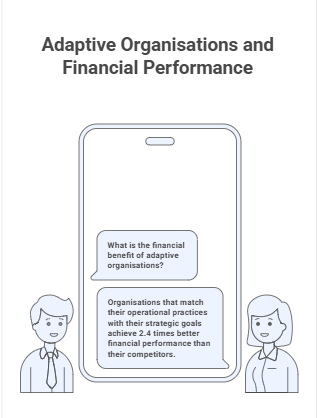
Source: Deloitte
Did You Know?
Organisations that move beyond simple efficiency and cultivate adaptive approaches which match their operational practices with their strategic goals achieve 2.4 times better financial performance than their competitors.
How does efficacy vs efficiency impact organisational performance?
The organisational performance of businesses depends on their cabability to achieve meaningful results through their operations which they need to maintain over time. Organizations that implement both strategies achieve better productivity gains and higher returns on investment while obtaining a competitive edge over their rivals.
The enterprise clients we have worked with experience a common issue which occurs when their efforts do not match expected outcomes. Business teams use activity level measurements to determine their success which leads to a situation where they cannot measure their efficiency and effectiveness.
Real-World Scenario
- A company launches multiple training sessions (efficient)
- But employees show no measurable skill improvement (ineffective)
The process of examining efficacy needs to include both effectiveness and efficiency because organizations require complete comprehension of these concepts.
How can leaders balance efficacy and efficiency effectively?
Leaders can balance efficacy vs efficiency through their implementation of a structured method which requires them to first establish suitable objectives before they work on improving their performance. The process provides operational development through its ability to create strategic control while maintaining operational efficiency and growth potential.
What Leaders Should Do: A Balanced Path
The ideal leadership approach to efficacy vs efficiency requires leaders to begin with their defined purpose, which they should use to check their progress and later improve their operational performance. Leaders must continuously measure both effectiveness (outcomes) and efficiency (process performance).
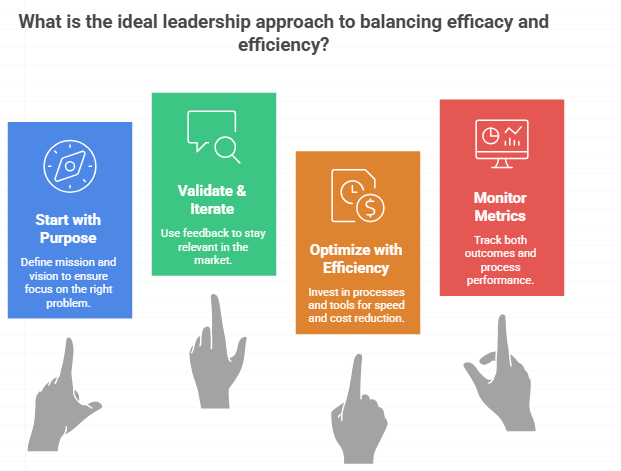
1. Start with purpose
Define mission, vision, the “why” behind what you do. Ask: are we solving the right problem?
2. Validate & Iterate
Use customer feedback, market signals to ensure your direction remains relevant.
3. Optimize with Efficiency
Once you know what matters, invest in processes, structure, tools to do it with speed and lower cost.
4. Monitor both kinds of metrics
Measure outcomes (efficacy) as well as inputs/time/cost (efficiency).
AI Readiness Score Card Free guide, instant download.
Get the Guide →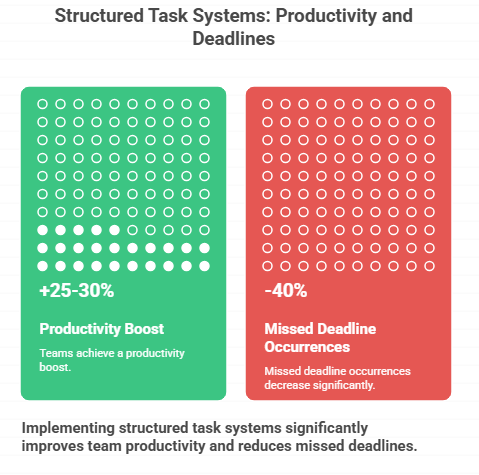
Source: Apps 365
Did You Know?
Industry studies demonstrate that teams which implement structured task systems achieve a productivity boost between 25 and 30 per cent while their missed deadline occurrences decrease by almost 40 per cent.
What role do self-efficacy vs efficiency play in leadership development?
Self-efficacy and efficiency work together in leadership development to determine a leader’s ability to achieve results through their operational skills. Self-efficacy drives innovative decisions, whereas efficiency creates stable processes which can expand their operations.
The leadership training process shows that people with strong self-belief take charge of their results while those who concentrate on efficiency will perform their tasks well but will not pursue new ideas.
The process requires this balance to create leaders who will succeed in future challenges.
Why Efficacy-First Thinking Drives Transformation
Efficacy-first thinking requires transformation initiatives to demonstrate alignment with strategic objectives before undergoing expansion. The framework prevents organisations from spending resources on process optimisation which does not produce valuable results.
Here’s the reality for L&D leaders: many organisations invest heavily in tools and automation and dashboards without confirming their ability to address fundamental issues.
Our consulting work found that organisations which redefined their strategic direction before expansion achieved higher returns than those which pursued efficiency upgrades.
Curious About Other Areas of Your Organization?
Explore our other free assessments and get a fuller picture of where you stand.
View All AssessmentsHow Can Ebullient Help?
Ebullient provides organisations with training and consulting frameworks that create measurable business results through their strategic execution system which enables organizations to evaluate their operational efficiency and effectiveness.
Our Approach
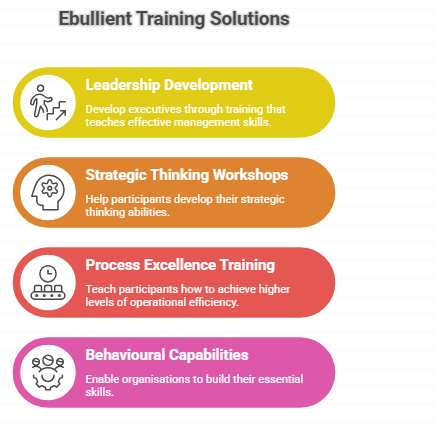
- Leadership development programmes develop executives through training that teaches effective management skills.
- Strategic thinking workshops serve as training sessions which help participants develop their strategic thinking abilities.
- Process Excellence Training teaches participants how to achieve higher levels of operational efficiency.
- The development of behavioural capabilities enables organisations to build their essential skills.
Efficacy vs efficiency exists as a strategic sequence which organisations must follow. Leaders must dedicate their time to performing essential tasks before they start executing their work tasks. The efficiency initiatives which organisations implement will deliver significant results because they create pathways to sustainable development and market edge.
Organisations which adopt this mindset achieve success through their work activities because each task they perform serves a greater strategic mission.
Want to meet the team?
Start with a 30-min conversation. No commitment needed.
Frequently Asked Questions
1. What is the difference between efficacy and efficiency in simple terms?
Efficacy means achieving the intended outcome, while efficiency means achieving it with minimum resources. The initial step for leaders requires them to recognise work activities which create business value before they proceed to enhance operational efficiency. The distinction between efficiency and efficacy functions as a fundamental concept which executives need to understand when making decisions about leadership.
2. Which is more important: efficacy or efficiency?
Efficacy versus efficiency shows that efficacy functions as the essential factor which guides actual progress towards correct objectives. The actual efficiency needs testing after establishing the correct goals together with appropriate execution methods.
3. Can an organisation be efficient but not effective?
Organisations can achieve operational efficiency without reaching their desired outcomes. Many organisations operate with high efficiency yet fail to achieve their organisational goals because they execute their operational processes without strategic value. The situation demonstrates a typical problem which occurs when performance measurement enters into direct comparison with effectiveness.
4. How can leaders improve both efficacy and efficiency?
Leaders achieve better results through their strategy execution work when they establish strategic goals which they distribute across their entire organisation. They should create training programmes which they will finance through their investments. They should adopt data-driven frameworks which guide their decision-making process.
5. What is the best way to train teams on efficacy vs. efficiency?
The best efficacy vs efficiency training combines strategic thinking, real-world case studies, and process optimisation techniques, ensuring teams understand both concepts and apply them effectively.