In today’s fast-changing business landscape, Artificial Intelligence (AI) is no longer a futuristic buzzword—it’s a practical tool transforming how managers lead, plan, and execute. Whether it’s automating routine tasks, analyzing data in seconds, or improving decision-making, AI helps managers save valuable time and reduce operational costs.
For modern managers juggling deadlines, reports, and people management, adopting AI isn’t just about efficiency—it’s about staying relevant and competitive in the digital age.
In this blog, we’ll explore five real-world AI use cases for managers that deliver measurable business impact, plus insights into the benefits, challenges, and implementation strategies.
How AI-Ready Is Your Organization, Really?
Take our free 4-minute assessment and get a personalized report on your leadership fluency, governance, and workforce readiness.
Take the Free AI Readiness Assessment →1. AI-Powered Data Analysis for Smarter Decision-Making
One of the most powerful uses of AI for managers lies in data analytics. Instead of spending hours compiling reports or analyzing spreadsheets, AI tools can instantly provide actionable insights.
How It Works
AI systems analyze vast datasets to identify patterns, forecast trends, and generate visual reports. This helps managers make faster, data-backed decisions—whether it’s forecasting sales, tracking team productivity, or monitoring customer feedback.
Example
Tools like Tableau AI, Power BI with Copilot, and Google Cloud Vertex AI enable managers to quickly visualize data, detect anomalies, and make strategic moves.
Result
Saves time on manual reporting
Reduces human errors in analysis
Improves strategic foresight
2. Automating Routine Tasks to Boost Productivity
Administrative and repetitive tasks consume a large chunk of managerial time. AI automation tools are now replacing manual workflows, allowing managers to focus on strategic priorities.
Examples of AI Automation
Scheduling & Email Management: Tools like Motion, Clara, and Calendly with AI can automatically schedule meetings and draft replies.
Document Handling: AI can summarize meeting notes, draft project proposals, or generate follow-up action items.
Workflow Automation: Platforms like Zapier and Make integrate apps to streamline data movement.
Impact
By automating repetitive tasks, managers save up to 40% of administrative time, leading to faster execution and improved team morale.
3. Enhancing Recruitment and Talent Management
Finding and retaining the right talent is one of the toughest challenges for managers. AI can revolutionize recruitment and HR management by eliminating biases, analyzing resumes at scale, and improving retention strategies.
Use Cases
Smart Resume Screening: AI systems can instantly match resumes with job descriptions.
Employee Sentiment Analysis: AI tools like Officevibe and Peakon help managers monitor employee engagement and mood.
Predictive Turnover Models: AI can flag employees at risk of leaving, allowing proactive retention.
Benefits
Shorter hiring cycles
Improved candidate matching
Data-driven HR decisions
4. AI for Customer Insights and Personalization
Managers overseeing marketing, sales, or customer service can leverage AI to better understand consumer behavior and tailor communication strategies.
How It Helps
AI systems analyze customer interactions—emails, chats, purchase history—to predict preferences and buying intent.
Example
AI Chatbots like Intercom or Drift automate 24/7 customer interactions.
CRM Insights from HubSpot AI and Salesforce Einstein predict which leads are most likely to convert.
Result
AI-powered personalization improves customer satisfaction, reduces churn, and enhances marketing ROI.
5. Predictive Maintenance and Resource Optimization
For managers in operations or production, predictive AI models can forecast equipment failures, supply chain issues, or workload imbalances before they happen.
Example
Manufacturing and logistics managers use IoT-powered AI systems to monitor machines and predict maintenance needs, reducing downtime and costs.
Benefits
Prevents unexpected failures
Saves repair costs
Increases operational efficiency
AI Readiness Score Card Free guide, instant download.
Get the Guide →The Benefits of Integrating AI into Management
Implementing AI brings measurable improvements across all managerial domains:
✅ Increased Efficiency: Automating tasks like scheduling, analysis, and reporting saves significant time.
✅ Better Decision-Making: Data-backed insights enhance accuracy and reduce guesswork.
✅ Cost Reduction: AI minimizes manual labor and resource wastage.
✅ Employee Empowerment: Managers can focus on mentoring and strategy, while AI handles routine tasks.
✅ Scalability: AI systems grow with your organization, adapting to changing needs.
Challenges Managers Face When Adopting AI
While AI offers tremendous value, it’s not without challenges:
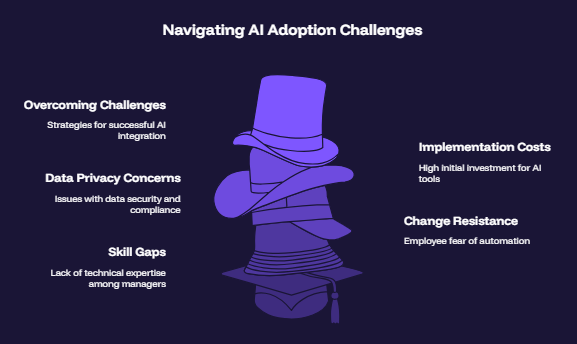
1. Skill Gaps
Managers may lack the technical knowledge to understand or implement AI tools effectively.
2. Change Resistance
Employees might fear automation, viewing AI as a threat to their roles.
3. Data Privacy Concerns
AI requires large amounts of data, raising issues of compliance and data security.
4. Implementation Costs
Though long-term savings are huge, the initial investment can be significant.
Overcoming These Challenges
Organizations can overcome these hurdles through AI literacy programs, ethical AI training, and change management strategies that emphasize collaboration between people and machines
Curious About Other Areas of Your Organization?
Explore our other free assessments and get a fuller picture of where you stand.
View All AssessmentsHow Managers Can Start Using AI (Step-by-Step)
-
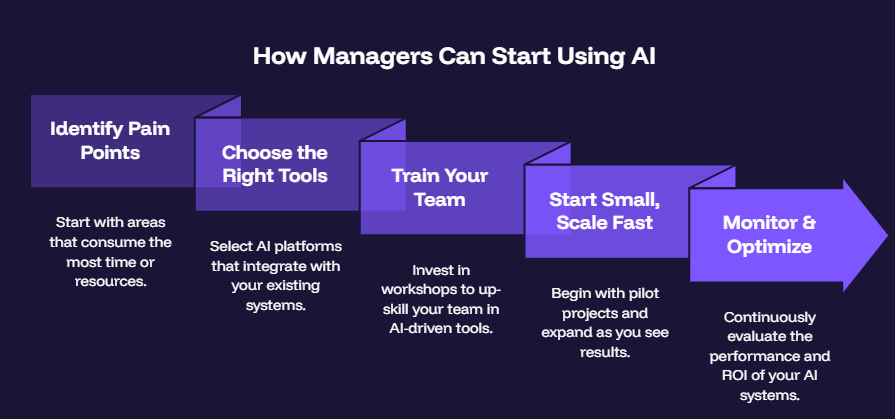
Identify Pain Points – Start with areas that consume the most time or resources.
-
Choose the Right Tools – Select AI platforms that integrate with your existing systems.
-
Train Your Team – Invest in workshops to upskill your team in AI-driven tools.
-
Start Small, Scale Fast – Begin with pilot projects and expand as you see results.
-
Monitor & Optimize – Continuously evaluate the performance and ROI of your AI systems.
Final Words: Train Your Managers to Lead in the AI Era
We are stepping into an era where managers need to lead through uncertainty, complexity, and accelerating technological change.
The organisations that manage to succeed in 2026 with AI tools. Instead, they will rework how work happens, how leadership gets practiced, how productivity is tracked, and even how collaboration works when AI-enabled ecosystems.
Managers who build real AI literacy for leaders, understand the concrete benefits of AI in the workplace, and truly adopt the best AI for managers 2026 strategies as major movers of organisational transformation.
And since AI adoption keeps speeding up across the globe, companies need to invest onto leadership readiness, employee capability development, and ethical AI implementation with competitive edge.
At Ebullient Consultancy, businesses are increasingly seeing that they need future-ready leadership strategies, AI-powered workplace transformation, and those practical learning frameworks that help managers keep thriving in the age of intelligent work.
Want to meet the team?
Start with a 30-min conversation. No commitment needed.
Frequently Asked Questions
What is AI for managers?
AI for managers refers to when managers use artificial intelligence systems, tools, and like algorithms to lead people and make decisions. It also supports teamwork, getting work done quicker and adapting to organisational changes.
What are the benefits of AI in the workplace?
The benefits include: improved productivity, quicker decision-making, better operational efficiency, less burnout, learning that scales across teams, and smoother workplace collaboration.
How should managers use AI to boost work productivity?
A manager can use AI for automating repetitive tasks, then for improving communication, generating useful insights, managing schedules, summarizing meetings, and making reporting way more streamlined.
Why do AI skills matter for leaders?
When leaders build strong AI skills, they can handle uncertainty more confidently, decide with more clarity, manage transformation with fewer surprises, and guide AI-enabled teams in a responsible way.
What are the best AI for managers trends in 2026?
In 2026, AI trends are: AI copilots, predictive intelligence, workflow automation, AI governance, leadership readiness, and human-centered AI implementation. Basically, organisations will want AI that supports people, make it easier to complete the task more efficiently.