

A change in management goes well when the organisation plans succession early, tells people clearly what will and will not change, supports the new leader well beyond their first 90 days, equips team leads to steady their teams, and rebuilds trust through consistent action. Leaders rarely fail alone; transitions fail when the system around them does.
Key takeaways at a glance
- Plan early. Treat succession as an ongoing process, not a reaction to a vacancy.
- Announce clearly. Say who, why, and what is not changing.
- Support beyond day 90. Plan a full year of structured support for the new leader.
- Brief managers first. Team leads steady their teams, so equip them before anyone else.
- Rebuild trust with action. Listen first, then deliver small, consistent wins.
Why a Change in Management Is a Make-or-Break Moment for Teams?
A new CEO, a new business head, a new reporting manager. Few events unsettle a workplace as quickly as a change in management. People start asking the same questions at once: What will change? What happens to my role? Will the priorities we agreed still hold?
How an organisation answers those questions in the first weeks shapes trust, engagement and performance for months afterwards. Yet most organisations plan the hire or the promotion carefully and leave the transition itself to chance.
This guide is for new managers and the teams who work with them. It explains what a leadership transition involves, why so many go wrong, what the latest research says, how a change in management a moment of renewal rather than disruption.
How Managerially Effective Is Your Organization, Really?
Take our free 4-minute assessment and get a personalized report on your leadership fluency, governance, and workforce readiness.
Take the Free AI Readiness Assessment →What is a leadership transition?
A leadership transition is the period in which responsibility for leading a team, function or organisation passes from one person to another. It runs from the first signal of change until the new leader is trusted, productive and aligned with the team, which usually takes much longer than the announcement date suggests.
Types of leadership transition
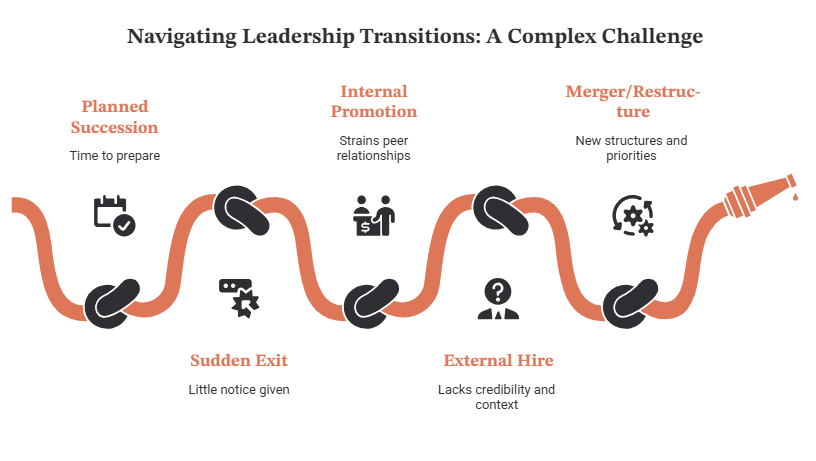
- Planned succession: a retirement or rotation with time to prepare.
- Sudden exit: an unexpected resignation, illness or removal with little notice.
- Internal promotion: a colleague becomes the manager of former peers.
- External hire: an outsider joins with no history in the organisation.
- Transition through a merger or restructure: management changes alongside new structures and priorities.
Each type carries different risks. Internal promotions can strain peer relationships, while external hires start without credibility or context.
Why it is more than an onboarding task
Onboarding covers paperwork, introductions and systems access. A transition also involves rebuilding relationships, resetting expectations and keeping the team’s work moving while everyone adjusts. Treating it as an HR checklist is one of the reasons it fails.
Source: Korn Ferry
Did You Know?
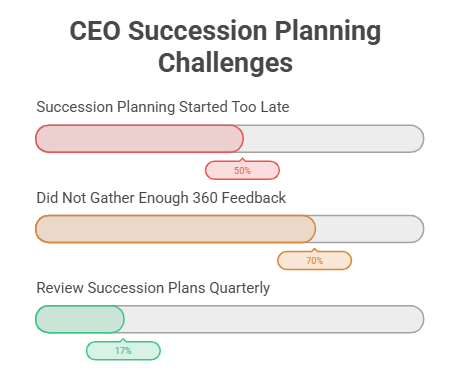
Half of boards say they started CEO succession planning too late. Korn Ferry’s 2026 CEO and Board Survey, which surveyed 250 board directors and chief executives in April 2026, found that 50% said succession planning started too late in their last CEO transition and 70% said they did not gather enough 360-degree feedback. Only 17% of organisations review succession plans quarterly.
Why do leadership transitions go wrong?
Transitions go wrong when planning starts late, the new leader is expected to succeed alone, and the team is left to guess what the change means. Leaders are rarely the only cause: the surrounding system of boards, managers and colleagues decides whether a capable person gets traction.
Succession planning starts too late
Korn Ferry’s 2026 CEO and Board Survey found that 50% of boards said succession planning started too late in their last CEO transition. The same research found that most boards agree succession works best as an ongoing process, yet few organisations review succession plans quarterly.
The 90-day myth
Many organisations support a new leader for three months and then step back. Research cited by the Institute of Coaching suggests that 40 to 50% of leaders underperform or fail within their first 18 months in a new role, and that onboarding focused narrowly on 90 days leaves them without structure during the critical integration period.
The manager layer is under strain
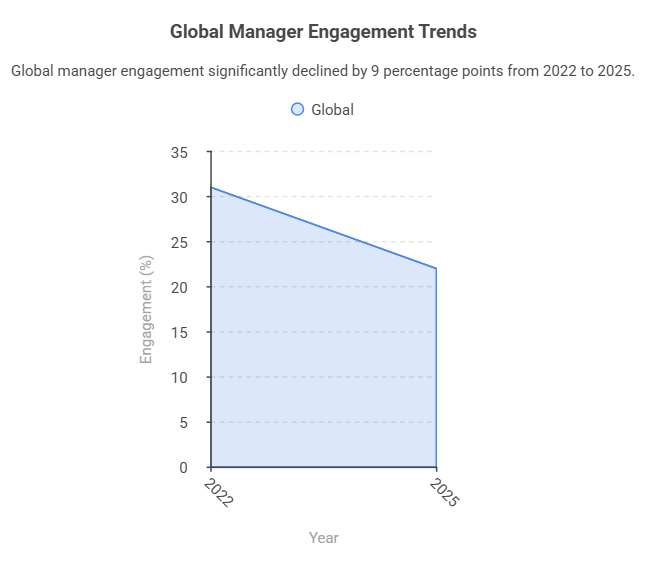
Gallup’s 2026 State of the Global Workplace report found that manager engagement fell from 31% in 2022 to 22% in 2025, and that lower manager engagement accounts for most of the recent decline in employee engagement. When managers are stretched thin, they have less capacity to steady their teams through a leadership change.
Trust has to be rebuilt, not inherited
A new leader inherits a role but not the trust the previous leader spent years building. Teams watch closely for consistency between what the new leader says and what they do.
A five-step playbook for leading through a change in management
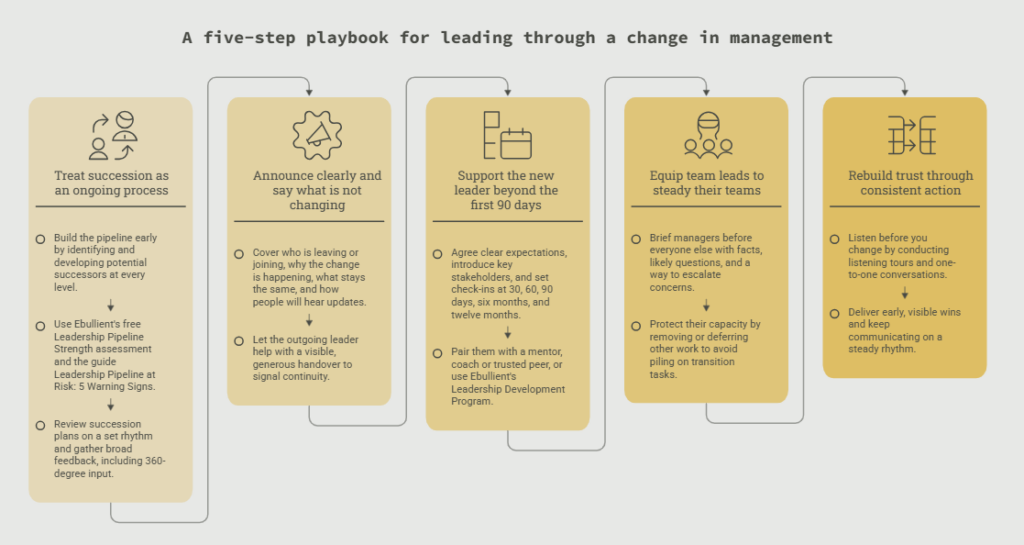
Step 1: Treat succession as an ongoing process
The best transitions start long before a vacancy.
Build the pipeline early
Identify and develop potential successors at every level, not just the top. If no one is ready when a leader leaves, organisations delay decisions or hire in a hurry. Ebullient’s free Leadership Pipeline Strength assessment and the guide Leadership Pipeline at Risk: 5 Warning Signs are practical starting points.
Review regularly
Review succession plans on a set rhythm, not only when someone resigns. Gather broad feedback on candidates, including 360-degree input, before decisions are made.
Step 2: Announce clearly and say what is not changing
Uncertainty spreads faster than information. A clear announcement reduces rumours and protects focus.
Cover four things
- Who is leaving or joining, and when.
- Why the change is happening.
- What stays the same, including priorities, commitments and ways of working.
- How people will hear updates and where they can ask questions.
Let the outgoing leader help
A visible, generous handover from the outgoing leader signals continuity and lends the newcomer early credibility.
Step 3: Support the new leader beyond the first 90 days
Treat the transition as a year-long integration, not a three-month sprint.
Give structure, not just a welcome
Agree clear expectations, introduce key stakeholders, and set honest check-ins at 30, 60 and 90 days, then at six and twelve months.
Pair them with a sounding board
A mentor, coach or trusted peer helps a new leader learn the unwritten rules and test their read of the situation. Ebullient’s Leadership Development Program supports leaders at this stage.
Step 4: Equip team leads to steady their teams
Teams look to their immediate managers first when leadership changes.
Brief managers before everyone else
Give team leads the facts, the likely questions and honest answers, plus a way to escalate concerns. Ebullient’s Manager Development Program prepares managers for exactly this role.
Protect their capacity
Given the strain on managers highlighted by Gallup, avoid piling transition tasks on top of full workloads. Remove or defer other work where you can.
Step 5: Rebuild trust through consistent action
Trust is rebuilt in small, repeated behaviours, not in a big speech.
Listen before you change
New leaders earn credibility by learning what is working, what is not, and why, before making visible changes. Listening tours and one-to-one conversations help.
Deliver early, visible wins
Pick a few early actions that show the leader keeps their word and understands the team’s real problems. Then keep communicating on a steady rhythm.
Source: Gallup
Did You Know?
Manager engagement has fallen nine points in three years, and India’s region fell furthest. Gallup’s 2026 State of the Global Workplace report shows global manager engagement dropping from 31% in 2022 to 22% in 2025. In 2025, South Asia, primarily India, saw an eight-point decline in manager engagement, the largest of any region.
A guide for new leaders: learn, align, act
A simple structure helps new leaders avoid two common traps: acting before they understand, and listening for so long that nothing moves.
Phase | Focus | Key questions |
First 30 days: Learn | Listen, observe, build relationships | What is working? What do people worry about? Who holds influence? |
Days 31 to 60: Align | Agree priorities and expectations | What matters most? How will we measure progress? |
Days 61 to 90: Act | Make a few visible decisions and start delivering | What small wins build momentum? What needs a bolder move? |
Months 4 to 12: Embed | Reinforce habits and revisit what you learned | What has changed? What needs adjusting? |
The 90-day framework is a useful starting point, but treat it as the first stage of a longer integration.
The Manager Effectiveness Framework Free guide, instant download.
Get the Guide →A guide for teams: how to handle a change in management
Teams are not passive in a transition. How colleagues respond shapes how quickly the new leader settles in and how smoothly work continues.
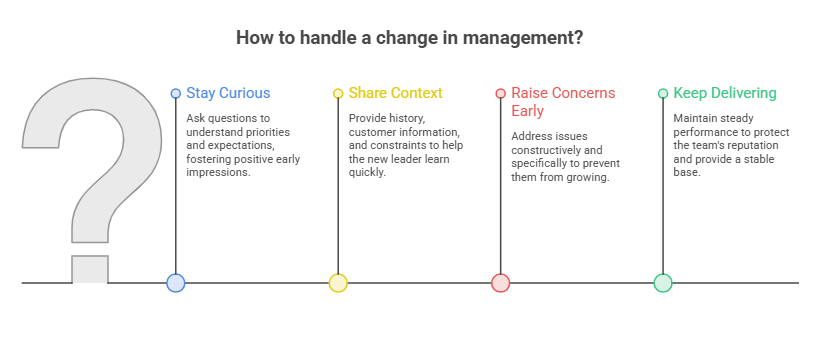
Stay curious, not defensive
Ask questions about priorities and expectations rather than assuming the worst. Early impressions form quickly on both sides.
Share context, not just complaints
Help the new leader understand history, customers and constraints. Context from the team is often the fastest way for a newcomer to learn.
Raise concerns early and constructively
If something is not working, say so in a specific, solution-minded way. Silence leaves problems to grow.
Keep delivering
Steady performance during a transition protects the team’s reputation and gives the new leader a stable base to build on.
Curious About Other Areas of Your Organization?
Explore our other free assessments and get a fuller picture of where you stand.
View All AssessmentsHow Ebullient Helps Organisations Through Leadership Transitions?
Ebullient is a leadership development and organisational transformation firm based in Noida, India. We have worked with 40+ organisations and developed 5,000+ professionals across sectors including banking, IT, manufacturing and pharma. We build leadership, culture and AI-readiness together, so that change, including a change in management, sticks.
Our approach
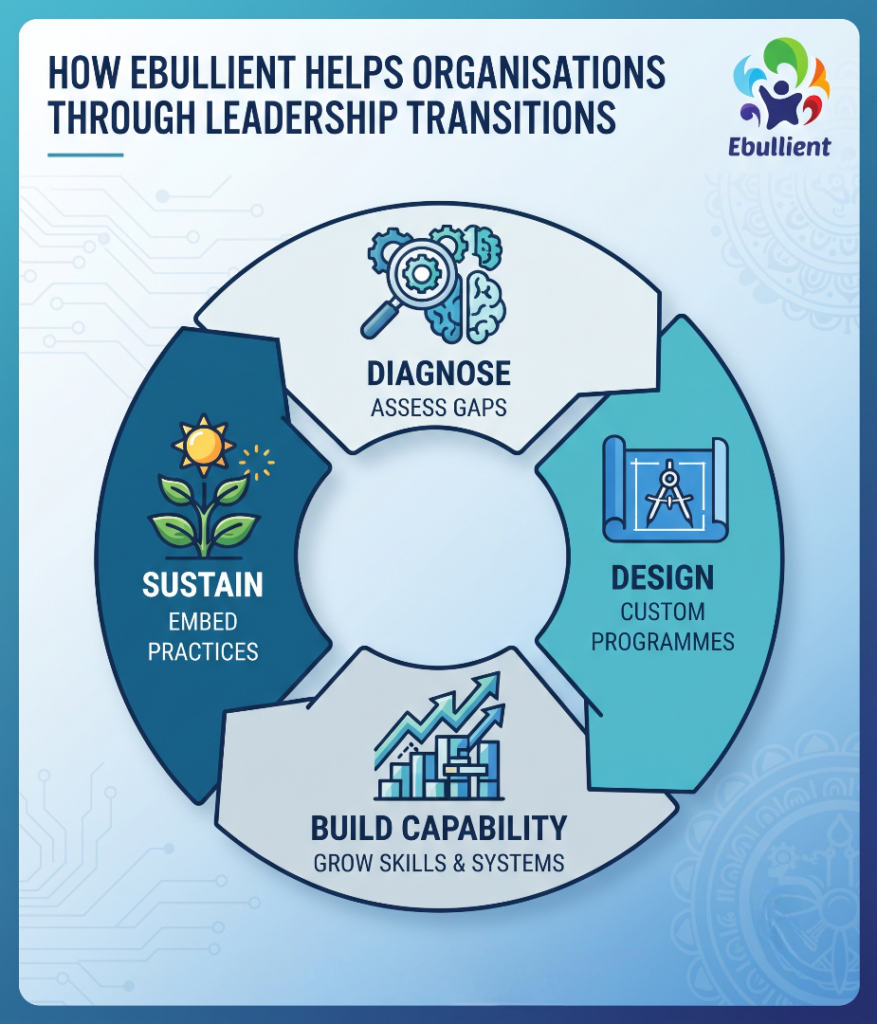
- Diagnose: we assess leadership, culture and readiness gaps before recommending anything.
- Design: every programme is built around your organisation’s context, not a standard template.
- Build capability: we develop skills and systems that grow with your business.
- Sustain: we embed practices that outlast the engagement.
Final thoughts
A change in management is one of the most closely watched moments in the life of any team. It can unsettle people, or it can reset energy and direction. The difference lies less in who the new leader is and more in how the organisation prepares, communicates and supports the people involved.
The research from 2026 is consistent: transitions are happening faster than many organisations are ready for, the managers who carry them are under strain, and employees increasingly judge leaders by how they handle change. These are all things an organisation can improve.
Start with three moves: make succession an ongoing conversation, brief your team leads first, and plan support for new leaders for a full year. Then keep communicating and keep your word.
Ebullient helps organisations build leadership pipelines, develop managers and navigate change so transitions stick.
Want to meet the team?
Start with a 30-min conversation. No commitment needed.
Frequently Asked Questions
What is a leadership transition?
A leadership transition is the period when responsibility for leading a team or organisation passes from one person to another. It runs from the first signal of change until the new leader is trusted, productive and aligned with the team.
How long does it take a new leader to settle in?
Most new leaders need more than the traditional first 90 days. Research cited by the Institute of Coaching indicates that 40 to 50% of leaders underperform or fail within 18 months, which is why support is best planned for the full first year.
How should employees cope with a new manager?
Stay curious, ask about priorities and expectations, share useful context about customers and history, raise concerns early and constructively, and keep delivering steady work. Early, honest conversations help both sides build trust faster.
What should leaders communicate during a change in management?
Communicate who is changing roles and when, why the change is happening, what stays the same, and how people will receive updates. Clear, early and repeated communication reduces rumours and protects focus.
How can organisations prepare for leadership succession?
Treat succession as an ongoing process. Develop potential successors at every level, review succession plans on a regular rhythm, gather broad feedback including 360-degree input, and plan structured support for new leaders for their first year.