

Most leadership teams still ask, “Are we performing well?” In the Age of Amplification, that question is too small. Technology, networks and expectations now magnify everything they touch. A fast organisation gets faster, a slow one gets slower, and a sloppy one scales its damage. The sharper question is this: what is our organisation scaling right now, performance or fragility?
This article introduces the AAA Leadership Model, Ebullient’s framework built on Agility, Adaptive Capability and Audacity. It explains how leadership teams can use it to move fast without breaking trust.
KEY TAKEAWAYS AT A GLANCE
- AAA means Agility, Adaptive Capability and Audacity. It is a leadership operating system, not a competency list.
- AI amplifies what an organisation already is. The real question is whether you are scaling performance or fragility.
- Three hidden latencies (decision, learning and courage) erode organisations quietly, long before results show it.
- AAA is stability, achieved a new way. It protects trust, reputation, resilience and profitability while changing what must change.
- A 90-day Sprint Pilot builds capability through real work and produces measurable proof, not poetry.
What Is the AAA Leadership Model?
The AAA Leadership Model is a future-fit leadership operating system built on three pillars: Agility (speed with integrity), Adaptive Capability (learning with humility) and Audacity (courage with responsibility). It helps leadership teams reduce decision latency, learning latency and courage latency so their organisations can move fast, learn in public and bet boldly without breaking trust.
AAA is not a competency list or a set of soft skills. It is the behavioural backbone required to run an organisation where volatility is the permanent condition, not the exception. Each pillar builds something specific and reduces a specific kind of drag.
Pillar | What it builds | What it reduces |
Agility | Speed with integrity | Decision latency |
Adaptive Capability | Learning with humility | Learning latency |
Audacity | Courage with responsibility | Courage latency |
Agility moves. Adaptive Capability learns. Audacity invents. Together, they future-proof the organisation.
How Leadership-Ready Is Your Organization, Really?
Take our free 4-minute assessment and get a personalized report on your leadership fluency, governance, and workforce readiness.
Take the Free Leadership Readiness Assessment →Why Does AI Amplify What an Organisation Already Is?
For most of the last century, business behaved like Newtonian physics: predictable, linear, cause and effect. Today’s operating reality is closer to quantum physics: nonlinear and interconnected, where small changes produce disproportionate outcomes and certainty is not available at any price. Four revolutions are driving the shift, all at once.
The digital revolution
Distance has collapsed between competitor and customer, between information and decision, between disruption and extinction. New technology tends to crawl until it reaches roughly eight to ten percent adoption, then tips into exponential growth. The incumbent who feels safe at five percent can be irrelevant long before saturation. Kodak did not fail slowly. Neither did Blockbuster.
The sustainability revolution
Regulatory, reputational, financial and supply-chain risk is pricing itself into every business model. This is not a brand story about responsibility. The real question is whether leadership leads the adaptation or is consumed by it.
The purpose revolution
Talent, customers and capital now back organisations that can credibly explain why they exist beyond making money. Loyalty is earned, not assumed.
The AI revolution
AI is the accelerant poured on the other three. It does not change the direction an organisation is already travelling; it amplifies it. Slow systems become slower at scale, cultures that avoid hard conversations drift faster towards danger, and genuinely adaptive leadership becomes exponentially more capable.
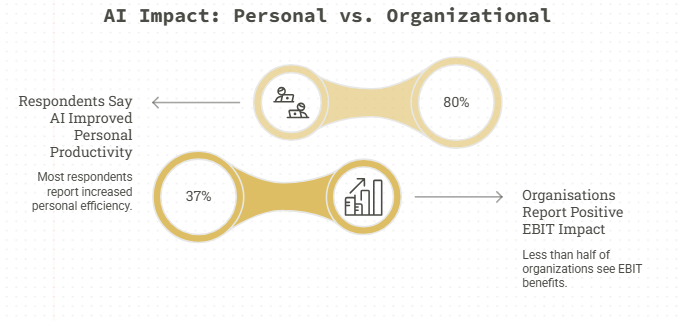
Source: McKinsey
Did You Know?
80% of respondents say AI has improved their personal productivity. Only 37% of organisations report any positive EBIT impact.
What Is Latency, and Why Is It the Hidden Enemy of Leadership Teams?
Most organisations do not fail dramatically. They fail quietly, through three forms of latency that compound long before anyone names them.
- Decision latency: time lost in approvals, handoffs, escalations and calls that get parked because nobody quite owns the risk of making them.
- Learning latency: the same problems returning under different names, quarter after quarter, because the organisation solved the symptom and never touched the pattern.
- Courage latency: safe rhetoric, timid bets and reinvention that keeps getting delayed until the window has closed.
In an amplified environment, latency is not an inefficiency. It is a risk that compounds silently. It erodes customer trust before it shows up in a survey, and it stops talent bringing ideas long before it shows up in exit interviews. Most declines are not caused by leaders working less hard. They happen because the organisation learned more slowly than the world around it changed.
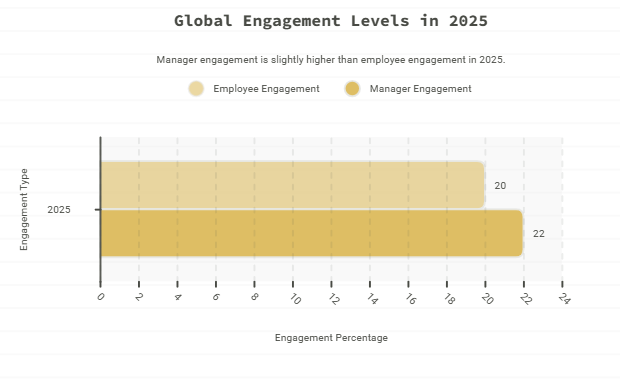
Source: Gallup
Did You Know?
Global employee engagement fell to 20% in 2025, and manager engagement dropped from 27% to 22% in a single year.
A five-question latency self-test
- How long does a significant cross-functional decision, such as a new market entry, partnership or pivot, actually take from first conversation to action? What would a well-funded, unencumbered competitor do in a tenth of that time?
- When did the organisation last change strategy because of a weak signal caught early, rather than a crisis that forced its hand?
- What is the one truth every member of the leadership team privately knows but nobody says in a formal meeting?
- What share of leadership time is genuinely forward-looking and exploratory, versus spent managing the present? Honestly answered, in most organisations it is under fifteen percent.
- If the three most disruptive trends in your industry fully materialise in the next twenty-four months, does the team have the capability, the courage and the cultural permission to lead through it?
An uncomfortable answer to any of these is not a future risk. It is a present gap, and competitors and customers are already measuring it, whether or not you are.
Why Does Leadership Success Become a Blind Spot?
Most leadership development is sold as a response to threat: the world is changing, so you must change. That framing tends to trigger defensiveness or performative compliance. It asks a successful leader to accept that the mental model behind their success is now their biggest blind spot. That is an identity challenge, not an information challenge, and more urgency or more data does not solve it.
Harvard’s Ronald Heifetz has argued that the work that produced leadership success can become the obstacle to further success. Three familiar beliefs show how the trap works:
- “More analysis leads to better decisions” is true in a slow world and a liability in a fast one.
- “Expertise is our advantage” holds for complicated problems. For complex ones, the real advantage is learning faster than your expertise goes stale.
- “Disruption happens to other industries” is the belief held by every incumbent shortly before disruption reached them.
So the reframe that matters is this: AAA is not change for the sake of change. It is stability, achieved a new way. It protects what already matters, including trust, reputation, resilience and profitability, while changing what must change to keep protecting it. The disruption a leadership team already feels is not the enemy. It is the largest source of competitive advantage available this decade, provided leaders have the operating system to convert it into learning and action faster than competitors can.
Is Your Leadership Pipeline at Risk? Free guide, instant download.
Get the Guide →How Do Agility, Adaptive Capability and Audacity Work Together?
Agility: speed with integrity
Agility is the speed dimension: how fast the organisation senses, decides and acts, without compromising its non-negotiables of safety, ethics and quality. Mastering it closes decision latency, reduces rework and builds execution cadences that generate compounding learning.
Adaptive Capability: learning with humility
This is the depth dimension. It separates problems that need better execution of what is already known from problems that need new thinking, new behaviour and new cultural patterns. Most teams apply technical fixes to adaptive challenges, which is why the same problems keep returning under new names. Adaptive Capability builds the courage to say, “we might be wrong, so let us test, listen and redesign the system.”
Audacity: courage with responsibility
Audacity is the direction dimension: imagining bold futures and acting under genuine uncertainty, with disciplined governance, staged experiments and explicit kill criteria. When the risk of timid action now exceeds the risk of bold action, audacity is no longer optional.
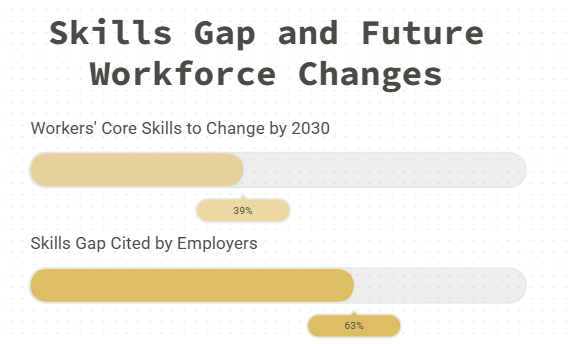
Source: WEF
Did You Know?
Employers expect 39% of workers’ core skills to change by 2030, and 63% already cite the skills gap as a key barrier to transformation.
Old Playbook vs Next Practice
The shift is less about new slogans and more about replacing assumptions that worked in a linear world.
Leadership dimension | Old playbook | Next practice |
Decisions | More analysis before every call | Speed with integrity, clear decision rights and staged commitment |
Expertise | Expertise is the advantage | Learning faster than expertise goes stale |
Disruption | It happens to other industries | Weak signals treated as strategy inputs |
Change | Urgency and threat | Stability achieved a new way |
Learning | Classroom time, off the job | Real work: live Breakthrough Projects |
Risk | Timidity feels safe | Bold bets with guardrails and kill criteria |
Measurement | Scorecards that police | Light-touch checks every 14 days that calibrate and scale |
How Does the 90-Day AAA Sprint Pilot Work?
AAA is built around a single design principle: the unit of learning is real work, not classroom time. Workshops, application sprints, peer circles and measurement all run through live Breakthrough Projects, where the behaviour being practised and the business outcome being pursued are the same thing.
That matters because large-scale change fails far more often than it succeeds. In McKinsey’s transformation survey, the average success rate was 26%, and transformations were 5.3 times more likely to succeed when senior leaders role-modelled the behaviour changes they asked of others. Strategy, technology and capital matter, but leadership behaviour decides the outcome.
How it runs across twelve weeks
Element | Cadence |
Workshops | 3 to 4 sessions in a questions-before-answers format, with tools and decision disciplines |
Application sprints | 10 to 14 days after each workshop, working on real Breakthrough Projects |
Peer learning circles | Ongoing, reinforced by sponsor reviews |
Measurement | Light-touch, every 14 days, built to calibrate and scale, never to police |
What a leadership team has after 90 days
- Decision latency reduced in one chosen value stream, with a measured cycle-time improvement.
- One adaptive challenge reframed, with one or two safe-to-try experiments actually executed.
- A portfolio of bold bets (core, adjacent and new), each with its own governance buffer.
- An embedded operating cadence: clear decision rights, escalation rules, closure discipline and after-action reviews.
- Movement on the AAA Behaviour Index from baseline to endline, plus internal case stories the organisation can reuse.
THE AAA PROMISE Less time lost. Decision latency measurably down in at least one value stream. Less repeat failure. Learning captured and recurrence reduced. More future bets. A portfolio of bold moves, resourced and reallocated with guardrails. |
What Is the AAA Latency Scan?
The AAA Latency Scan is a ninety-minute session with the leadership team, built around twelve questions rather than a slide deck about AAA. It is an invitation to find out, together, whether there is a problem worth solving. It maps three things with precision:
- Where decisions are stalling, and why.
- Where the same failures keep recurring under different names.
- Where courage is being quietly rationed.
It produces one executive output: the top three latency leaks, the top three experiments worth running, and a ninety-day pilot outline built around your own value streams. It is useful on its own, whether or not the engagement goes any further.
What to Do About It This Quarter
You do not need a programme to begin. These five moves will show you where latency is hiding:
- Time one real decision. Pick a value stream and measure a significant decision from first conversation to action. That number is your baseline for decision latency.
- Audit your recurring problems. List the three issues that returned under different names this year, and label each one technical or adaptive.
- Surface the unspoken truth. Open your next leadership meeting with the question, and collect answers anonymously if you need to.
- Protect forward-looking time. Review the leadership calendar and block a recurring slot for exploration, so it does not shrink to the usual fifteen percent or less.
- Stage one bold bet. Define a small experiment with a budget cap, a review date and explicit kill criteria, then run it.
Curious About Other Areas of Your Organization?
Explore our other free assessments and get a fuller picture of where you stand.
View All AssessmentsHow Ebullient Helps Leadership Teams Build AAA
At Ebullient, we humanise technology through culture and capability. AAA sits at the centre of four areas of work:
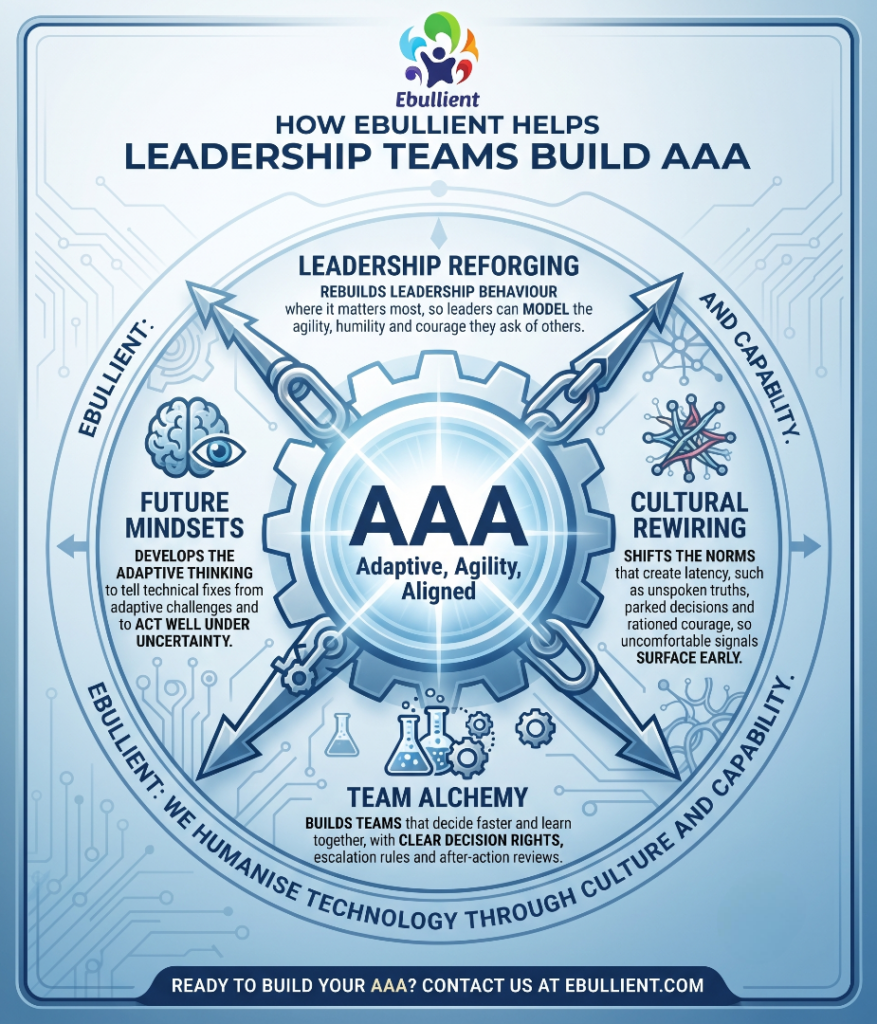
Leadership Reforging
Rebuilds leadership behaviour where it matters most, so leaders can model the agility, humility and courage they ask of others.
Cultural Rewiring
Shifts the norms that create latency, such as unspoken truths, parked decisions and rationed courage, so uncomfortable signals surface early.
Team Alchemy
Builds teams that decide faster and learn together, with clear decision rights, escalation rules and after-action reviews.
Future Mindsets
Develops the adaptive thinking to tell technical fixes from adaptive challenges and to act well under uncertainty.
Want to meet the team?
Start with a 30-min conversation. No commitment needed.
Frequently Asked Questions
What does AAA stand for in leadership?
AAA stands for Agility, Adaptive Capability and Audacity. Agility is speed with integrity, Adaptive Capability is learning with humility, and Audacity is courage with responsibility. Together they form a leadership operating system that helps organisations reduce decision, learning and courage latency in complex, fast-changing environments.
What is the Age of Amplification?
The Age of Amplification describes a period in which technology, networks and expectations magnify whatever an organisation already is. Speed scales speed, delay scales delay, ethics compound trust and sloppiness compounds damage. AI does not fix an organisation on its own; it amplifies existing strengths and existing fragilities.
What is latency in leadership?
Leadership latency is the hidden time and courage lost between sensing a change and acting on it. It appears as decision latency (slow approvals and parked calls), learning latency (recurring problems) and courage latency (timid bets and delayed reinvention). In complex environments it compounds silently and becomes a strategic risk.
Who is the AAA Leadership Model designed for?
It is designed for CEOs, founders, business heads and leadership cohorts facing digital acceleration, complex trade-offs, sustainability pressure, talent shifts or trust scrutiny. The model is domain-agnostic because complexity behaves similarly across industries, so it can be applied across sectors and built around each organisation’s own value streams.
How can we start with AAA at Ebullient?
Start with the AAA Latency Scan, a ninety-minute session with your leadership team built around twelve questions. It surfaces your top three latency leaks and the top three experiments worth running, then outlines a ninety-day pilot. Book a discovery call at ebullient to begin.